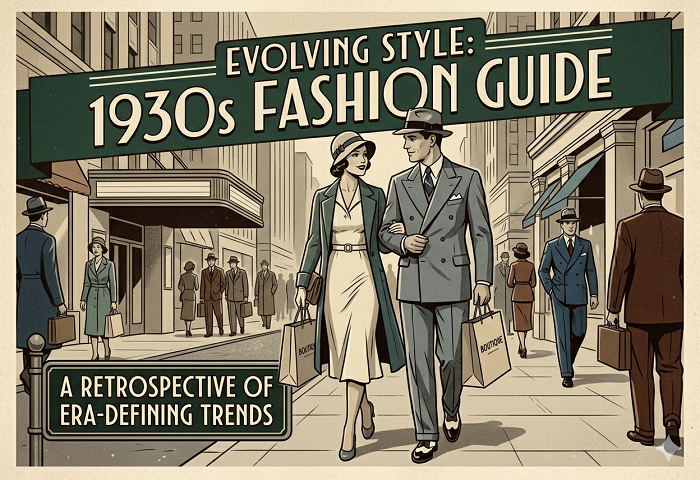
Introduction
Picture a silver screen goddess in a liquid satin gown that clings and flows with every step. Picture a broad-shouldered man in a double-breasted suit, fedora tilted low, cigarette case in hand. Picture women gathered around a cinema in a Depression-era town, studying every detail of what Joan Crawford is wearing because it is the one form of glamour freely available to them that week. That is 1930s fashion in a single mental image: the impossible, intoxicating coexistence of hardship and elegance, of ordinary life and extraordinary aspiration.
The decade sandwiched between the Roaring Twenties and the outbreak of World War II is arguably the most underappreciated era in fashion history. It is squeezed on both sides by decades that tend to steal all the attention — the iconic flappers before, the utility-driven wartime silhouette after. But this era deserves a stage of its own. It was the decade that gave us the bias cut, the little black dress, the power shoulder, ready-to-wear clothing for the masses, and perhaps the most cinematically glamorous evening wear ever conceived. It was a decade that turned scarcity into style and made Hollywood into the world’s most powerful fashion magazine.
This is the complete guide to 1930s fashion: the context that shaped it, the women who defined it, the designers who transformed it, the men who embodied it, and the legacy it left on every decade that followed.
The World That Shaped 1930s Fashion
You cannot understand 1930s fashion without understanding the Great Depression. When the stock market crashed in October 1929, it sent economic shockwaves across the globe that did not relent for the better part of a decade. Unemployment soared, wages collapsed, and millions of families could no longer afford the kind of seasonal wardrobe spending that the booming 1920s had encouraged. Extravagance was not just unaffordable — for many people, it felt inappropriate. Morally wrong.
The contrast with the previous decade could not have been sharper. The 1920s had been all about liberation and excess — short skirts, dropped waists, bobbed hair, the whole flapper revolution. 1930s fashion moved in the opposite direction almost immediately. Hemlines dropped back to the calf and eventually the ankle. Waistlines returned to their natural position on the body. The boyish, androgynous silhouette of the Twenties gave way to something more deliberately, consciously feminine. Women’s bodies were celebrated again rather than hidden under a straight column of fabric.
But it was not merely a reaction against the previous decade. Economic pressure forced genuine creativity. Women who could not afford new clothes became extraordinarily clever with what they had. Accessories — gloves, silk scarves, costume jewelry, hats — became central to 1930s fashion precisely because they could transform a basic dress into several different outfits without requiring an entirely new garment. The art of the accessory reached its apex in this decade.
Most famously, the flour sack dress became one of the unexpected style moments of the era in America. As families grew increasingly desperate, women began sewing clothing from the cotton sacks that held flour and grain. Flour manufacturers, upon discovering this, began printing their sacks with beautiful floral and geometric patterns — an extraordinary moment when industry responded to consumer ingenuity and genuine need intersected with design. Flour sack dresses were not high fashion, but they were an honest, inventive expression of the era’s values: making beauty from whatever materials were at hand.
Against all of this financial grimness, Hollywood arrived like a searchlight.
Hollywood and the Golden Age of Glamour
No force shaped 1930s fashion more profoundly than the cinema. The 1930s were the Golden Age of Hollywood — the decade of Jean Harlow, Greta Garbo, Joan Crawford, Katharine Hepburn, Marlene Dietrich, Ginger Rogers, and Bette Davis. These women were not just actresses. They were living fashion mannequins viewed by tens of millions of people every week, in an era before television and long before social media, when the cinema screen was the only place most ordinary people encountered unattainable glamour.
Women across America and Europe sat in darkened cinemas and studied every stitch. They noted the cut of a sleeve, the drape of a neckline, the placement of a belt. And then — crucially — they went home and tried to recreate what they had seen, either by sewing their own versions, purchasing affordable ready-to-wear copies, or simply adapting existing pieces. The actresses understood their influence and many of them actively endorsed dressmaking patterns and ready-to-wear catalogues, making the imitation of Hollywood style a truly democratic pursuit.
Jean Harlow wore Madeleine Vionnet’s bias-cut satin gowns on screen and every woman who saw her wanted one. Joan Crawford’s wide-shouldered look in the film Letty Lynton, designed by costume designer Gilbert Adrian, is credited with triggering a nationwide shoulder pad trend. Katharine Hepburn and Marlene Dietrich dared to wear trousers — and in doing so, quietly began normalizing women’s pants decades before they became standard. These moments defined the decade’s style as powerfully as any Paris couturier’s collection.
The costume designers behind those screen performances were themselves extraordinary creative forces. Gilbert Adrian at MGM and Edith Head at Paramount were as influential in shaping 1930s fashion as Vionnet or Chanel. They worked at the intersection of fantasy and reality, creating looks extravagant enough for the cinema screen but aspirational enough that audiences could see themselves wearing something inspired by them.
Women’s 1930s Fashion: The Key Silhouettes and Trends
What does the ideal silhouette for women in this era actually look like? It is immediately recognizable, and in many ways it remains one of the most beautiful dress shapes in history.
The natural waist is the anchor of the whole look. After the dropped-waist, hip-skimming shapes of the late Twenties, the waist returned to its anatomical position and stayed there for the entire decade. Everything built outward from that point: broader, more structured shoulders above, and a skirt that flowed smoothly from the waist to the mid-calf in daylight and to the floor for evening.
The Bias Cut is perhaps the single most technically significant contribution of 1930s fashion to the history of clothing construction. Developed by the French designer Madeleine Vionnet — who had been experimenting with the technique since 1922 but whose innovations were widely adopted by others only in the thirties — the bias cut involves slicing fabric at a 45-degree angle to the grain rather than along it. The result is a garment with extraordinary fluidity: it clings softly to the body’s natural curves, moves with the body rather than against it, and creates that liquid, sinuous evening gown silhouette that remains the visual emblem of the era. Vionnet is often called the “Queen of the Bias Cut,” and for good reason. Her work changed the physics of dressing.
The Shoulder was the other defining structural element of the decade’s look. Where the Twenties had minimized the shoulder in its pursuit of a flat, boyish line, the Thirties celebrated it — with puffed sleeves, butterfly sleeves, banjo sleeves, and eventually structured shoulder pads that created a broad, powerful V-shape tapering to a narrow waist. This was both aesthetic and psychological. In an era of economic powerlessness, wide strong shoulders were a quiet assertion of presence and authority.
Daywear in the thirties was characterized by the midi-length print dress — typically cotton or rayon with a belted waist, a modest neckline, and a flowing skirt that reached the mid-calf. Floral patterns were enormously popular, as were geometric Art Deco prints. Suits consisting of a tailored skirt and jacket were worn by professional women and upper-middle-class consumers. The bolero jacket made its appearance as a versatile layering piece.
Evening wear is where the decade really showed its opulence. Long bias-cut gowns in liquid silk, satin, or chiffon. Backless silhouettes — the back was considered the decade’s most daring erogenous zone, emphasized with plunging backlines adorned with jewelry. Elaborate beading, sequins, feather trimmings, and embroidery elevated evening dresses to works of art. Fur — both genuine and imitation — trimmed collars, cuffs, and jacket hems. The little black dress, which Coco Chanel had introduced in 1926 but which only truly caught fire in the Thirties, became the definitive evening staple.
Swimwear and sportswear deserve a separate mention because they represent one of the most significant cultural shifts embedded in the decade’s wardrobe. Sunbathing became fashionable, and women’s swimwear evolved accordingly: lower-backed cuts, more skin exposure, and by the late Thirties, the first tentative appearances of two-piece swimwear. Wide-legged beach pajamas and high-waisted sailor pants were worn for leisure and outdoor activity — elegant, relaxed, and deliberately unbothered about convention.
The Great Designers Who Defined the Era
The decade’s style was shaped by a remarkable concentration of creative genius in the Paris couture houses, disrupted and democratized by Hollywood, and made accessible by the growing ready-to-wear industry.
Madeleine Vionnet stands as the technical genius of the decade. Her mastery of the bias cut gave the era its most iconic silhouette. She worked in an almost architectural way, draping fabric directly on small wooden mannequins until the geometry was perfect, and then transferring those patterns to full-scale garments that moved like nothing ever had before.
Coco Chanel brought her philosophy of comfortable, understated elegance into the Thirties with enormous effect. She famously declared “I want women to eat and laugh without fear of fainting,” and her designs honored that principle — jersey suits that allowed free movement, the little black dress that could be dressed up or down, clean lines that resisted the fussiness of much contemporary 1930s fashion. In a decade when money was tight for almost everyone, Chanel’s restrained aesthetic spoke directly to the mood of the times.
Elsa Schiaparelli was Chanel’s opposite and rival, and the tension between them produced some of the most interesting conversations in 1930s fashion history. Where Chanel was minimal, Schiaparelli was maximalist — theatrical, surrealist, sometimes downright bizarre, and always arresting. She collaborated with Salvador Dalí, producing the famous lobster dress, a shoe-shaped hat, and a skeletal evening jacket. She invented the wrap dress, popularized culottes, introduced shocking pink — a color she called Schiaparelli pink — to the fashion vocabulary. Her contribution to 1930s fashion was the reminder that clothes could be art, that the female body was a canvas as much as it was a functional form.
Jeanne Lanvin brought luxurious fabrics and deeply feminine silhouettes. Norman Hartnell dressed British royalty with intricate embroidery and structured glamour. Hollywood’s Gilbert Adrian may have reached more women through cinema than all the Paris couturiers combined.
Men’s 1930s Fashion: The Drape Suit and the Silver Screen
Menswear underwent its own significant transformation, and Hollywood was again the driving force. The 1920s dandy, with his tight-waisted, stiffly structured silhouette, gave way to something broader, more relaxed, and more powerfully physical.
The defining menswear development of 1930s fashion was the drape suit — a style developed in Savile Row that featured a loosely cut chest with a subtle drape of fabric, broad shoulders, and tapered trousers. This suit was enthusiastically adopted by Hollywood stars including Cary Grant, Fred Astaire, and Gary Cooper, who replaced the European aristocracy as the dominant male fashion influences of the era. These men understood instinctively what a camera did to tailoring, and they wore clothes with a kind of studied casual perfection that became the template for masculine elegance for decades afterward.
The trouser evolved as well. The wide-legged Oxford bags of the mid-Twenties narrowed and tapered by the mid-Thirties. High waists remained standard, and pleated fronts were universal. Double-breasted suits — broader lapels, more buttons, more presence — were enormously popular. The fedora was the hat of the decade, worn low over the brow in a manner associated with both the movie hero and, less flatteringly, the screen gangster.
The influence of film on men’s 1930s fashion reached even into intimate apparel. When Clark Gable removed his shirt in It Happened One Night (1934) to reveal he wore no undershirt beneath it, sales of men’s undershirts slumped across America almost immediately. This single scene represents one of the most extraordinary examples of the cinema’s power to shape everyday behavior and style — not by showing an aspirational garment, but by the absence of one.
Fabrics, Textiles, and the Technological Revolution
The decade’s clothing benefited from — and in many ways was defined by — significant advances in textile technology. The widespread adoption of rayon (known at the time as “artificial silk”) made the slinky, drapey aesthetic of the decade available to women who could never afford genuine silk or satin. Rayon’s lightness, fluidity, and low cost democratized style in the most practical way possible.
Nylon, which was developed by DuPont in 1938 and first used in women’s stockings in 1939, was just beginning to reshape the hosiery market as the decade closed — a technological breakthrough that would truly transform women’s everyday dress experience in the decade to come. The zipper, invented years earlier, became widely used in clothing for the first time during the Thirties, replacing buttons and hooks in dresses, skirts, and trousers with a clean, modern efficiency that perfectly matched the decade’s aesthetic ambitions.
Knitted jersey fabric — already associated with Chanel’s practical elegance — became widely used for everyday daywear and sportswear, stretching comfortably with the body and requiring far less stiff understructure than woven cloth. Tweed was the fabric of smart country wear and tailored suits. Velvet provided evening weight and drama. Together, these materials built the tactile vocabulary of 1930s fashion — a vocabulary that balanced aspiration with pragmatism at every price point.
Accessories: The Art of Doing More With Less
One of the most enduring lessons of 1930s fashion is the power of the accessory. When your budget does not stretch to a new wardrobe for every season, the right hat, gloves, or necklace can completely transform the emotional register of a dress you have worn a hundred times.
Women of the 1930s understood this intuitively, and the accessory became an art form. Hats were an essential daily item — berets, slouch hats in the Greta Garbo mold, turbans for evening, small tilt hats perched at a rakish angle, and knit caps for casual daywear. The rule was that shoes, handbag, and hat should match, creating a coordinated elegance from the ground up. Two-tone oxford shoes and T-strap heels with chunky ankles were the dominant footwear shapes of 1930s fashion. Long gloves were mandatory for evening; shorter gloves for day.
Jewelry was prominent but often imitation. The high cost of genuine precious stones pushed designers and consumers toward costume jewelry — paste diamonds, glass beads, Bakelite bangles, and intricately worked base metals. Coco Chanel, who had worn real pearls, began mixing them with fakes and pronouncing the combination entirely acceptable, which it was. The resulting aesthetic — bold, layered, proud of its artifice — became one of the signature accessories looks of the decade.
1930s Fashion’s Legacy in the Modern Wardrobe
The influence of this remarkable decade on how we dress today is more pervasive than most people realize. The bias-cut slip dress — a genuine 1990s phenomenon and a staple of current wardrobes — is a direct descendant of Vionnet’s 1930s innovations. The wide-leg trouser, which cycles in and out of mainstream fashion every decade or so, was normalized for women in the Thirties. The little black dress has never left. The power shoulder returned with ferocity in the 1980s and makes regular reappearances. The principle that women can wear trousers as freely as any man was quietly established in those years by Katharine Hepburn, Marlene Dietrich, and the practical demands of a changing workforce.
Contemporary designers return to 1930s fashion for inspiration constantly — to the bias cut’s forgiving, body-celebrating fluid shape, to the Art Deco geometric prints, to the broad-shouldered glamour of Old Hollywood. When a modern designer sends a satin column gown with a plunging back down a runway, they are, whether consciously or not, reaching directly into the 1930s.
The more philosophical legacy of 1930s fashion may be even more interesting: the demonstration that constraint generates creativity. The decade proved that financial hardship does not kill style — it refines it, forces it to be cleverer and more resourceful, and sometimes produces its most durable innovations. The flour sack dress and the Vionnet gown are not opposites. They are twin expressions of the same creative impulse: the human desire to be beautiful even when — especially when — the world makes it difficult.
How to Wear 1930s Fashion Today
If you want to incorporate 1930s fashion into your contemporary wardrobe, the entry points are surprisingly accessible. A midi-length bias-cut slip dress in silk or satin is the most complete single expression of the era. Pair it with T-strap heels, a small clutch, and a simple pendant necklace, and the 1930s silhouette is achieved with minimal effort.
For a daywear interpretation of 1930s fashion, a belted midi dress in a floral or geometric print worn with oxford shoes and a small hat captures the era beautifully. Wide-leg high-waisted trousers with a silk blouse and loafer achieve the Katharine Hepburn end of the spectrum — more modern, more androgynous, still unmistakably Thirties in spirit.
The accessories are often the most powerful way to invoke 1930s fashion without a costume shop. A beret worn at a slight angle, a silk scarf knotted at the neck, a string of pearls, or a pair of white gloves all carry the aesthetic instantly and integrate effortlessly into modern wardrobes. The 1930s understood that the most lasting style statements are made in the details — and that principle has never gone out of fashion.