Introduction
Few decades in history have shaped the way we dress as profoundly and permanently as the 1940s. The story of 1940s fashion is not simply a tale about clothing — it is a story about survival, creativity, resilience, and a generation of people who refused to let hardship rob them of elegance. Shaped almost entirely by the realities of World War II, 1940s fashion produced silhouettes, garments, and styling philosophies that continue to influence modern designers, vintage clothing enthusiasts, and everyday dressers more than eighty years later.
Understanding 1940s fashion requires stepping into the context of the era. By 1940, the war had completely altered the global economic landscape. Governments in the United Kingdom and the United States began rationing essential materials including wool, silk, nylon, leather, and rubber — all of which were critical to the war effort. The UK introduced the Utility Clothing Scheme in 1941, marked with the now-iconic CC41 logo. The United States responded with its own L-85 regulations, which imposed strict limitations on how much fabric designers could use and how garments could be constructed. These constraints, rather than diminishing the decade’s style, actually drove some of the most creative and disciplined design work the world had ever seen.
This complete guide covers everything you need to know about 1940s fashion — from women’s wartime dresses and men’s utility suits to post-war glamour and how to wear vintage 40s style beautifully in your life today.
The Historical Context That Shaped 1940s Fashion
To truly appreciate 1940s fashion, you need to understand the forces that created it. World War II was the single most powerful influence on clothing during this decade. When materials were rationed and the manufacturing industry was redirected toward military production, everyday men and women had to adapt dramatically in how they thought about their wardrobes.
The British government launched the famous “Make Do and Mend” campaign, actively encouraging citizens to repair, rework, and repurpose their existing clothing rather than purchasing new items. This philosophy of creative resourcefulness became deeply embedded in the identity of wartime dressing. Women became expert home dressmakers, transforming pre-war pieces by altering necklines, shortening hemlines, and repurposing spare fabric into new pockets, sleeves, and decorative details.
Simultaneously, the changing role of women in society had a direct and lasting impact on 1940s fashion. As millions of men went to war, women entered the workforce in unprecedented numbers — working in factories, on farms, and in military support roles. This practical shift meant that clothing had to accommodate physical labor and active daily life in ways it never had before. Trousers, dungarees, coveralls, and the iconic turban-style headscarf all became central elements of everyday women’s wardrobe as a direct result of this shift.
What makes 1940s fashion so remarkable is that even within these extraordinary constraints, designers, home dressmakers, and everyday people found ways to maintain grace, elegance, and personal style. The decade produced some of the most beautifully structured and timeless silhouettes in all of fashion history — silhouettes that owe their existence entirely to the discipline of doing more with less.
1940s Women’s Fashion: The Essential Silhouette
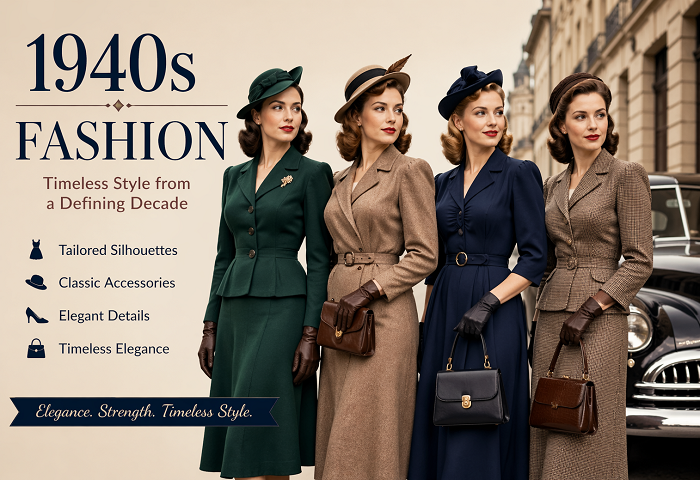
The defining silhouette of 1940s fashion for women was structured, practical, and quietly powerful. The wartime look was built around a few core principles: a fitted bodice, a slightly raised waistline, boxy padded shoulders that created a broad angular upper body, and a hemline that sat just below the knee. This shape was simultaneously feminine and utilitarian — designed to look polished while using the minimum possible fabric.
The Utility Dress
The utility dress was perhaps the defining garment of 1940s fashion for women. Simple in construction, practical in wear, and available to purchase using government-issued ration coupons, utility dresses came in plain wools, rayon, and jersey fabrics. They were typically single-breasted with minimal decorative detailing, narrow lapels, and functional patch pockets. Despite their austere origins, these dresses were beautifully cut — proving that good design requires no excess.
The Tea Dress
If the utility dress was the workhorse of wartime women’s style, the tea dress was its romantic soul. Characterized by floral prints, sweetheart necklines, puffed cap sleeves, and gently flared A-line or gored skirts, the tea dress embodied the femininity that women of the era refused to surrender. Tea dresses from this period were worn to dances, social gatherings, and weekend events, and they remain one of the most beloved and widely replicated garments from the entire decade.
Today, the tea dress is one of the most popular vintage-inspired styles on the market. Contemporary brands including Collectif, Lindy Bop, and Hell Bunny produce modern tea dresses that capture the authentic spirit of 1940s fashion beautifully.
High-Waisted Trousers and Workwear
One of the most lasting legacies of 1940s fashion was the widespread adoption of women’s trousers. Before the war, trousers were rarely worn by women in public settings. The practical demands of wartime work changed this permanently. Wide-leg, high-waisted trousers became a staple — worn tucked in with blouses, paired with knitwear, and increasingly accepted as everyday dress rather than strictly workwear.
The high-waisted trouser silhouette remains one of the most consistently flattering pant shapes ever designed, and it continues to dominate women’s trends in the 2020s. The direct line from wartime necessity to contemporary style could not be more clear.
Shoulder Pads and Structured Jackets
Shoulder pads were a signature element of 1940s fashion for women, creating the broad-shouldered angular silhouette that defined the era. Jackets, blouses, and even knitwear were built with structured padding at the shoulders, giving women a strong, assertive physical presence that mirrored their newly expanded role in society. Women’s suits of this period — typically a single-breasted jacket with a matching knee-length skirt — became a symbol of wartime dignity and practical elegance.
Post-War Style: The New Look
The story of 1940s fashion does not end with the war. In 1947, French designer Christian Dior launched his debut collection, immediately dubbed the “New Look” by the fashion press. This collection was a radical departure from the utilitarian angularity of wartime dress. Dior’s New Look featured rounded natural shoulders, a dramatically nipped waist, and full sweeping skirts that fell to mid-calf — a celebration of the end of rationing and the return of luxury.
The New Look was controversial. Many women who had spent years adapting to wartime austerity found Dior’s extravagance jarring. But it was undeniably transformative, marking the transition from the structured restraint of 1940s fashion into the ultra-feminine silhouettes of the 1950s.
1940s Men’s Fashion: Tailored Restraint and Military Influence
While women’s style tends to dominate popular discussion of the era, 1940s fashion for men was equally compelling — defined by disciplined tailoring, military influence, and an understated elegance that speaks powerfully across the decades.
The Wartime Men’s Suit
The men’s suit was the cornerstone of 1940s fashion for men. Under wartime regulations, suits were redesigned to conserve fabric. Jackets featured narrower lapels, single-breasted constructions, and simplified details. Trousers lost their traditional turn-ups and were cut slightly narrower than the wide-leg styles of the 1930s. Vest pieces were largely eliminated from three-piece suits under L-85 rules.
Despite these restrictions, men’s tailoring maintained a commitment to sharp, precise construction. The hallmark of the wartime men’s suit was broad shoulders, a defined chest, and a fitted waist — creating a silhouette that communicated strength and authority. These suits were typically made in wool in dark or muted tones: navy, charcoal, brown, and grey dominated men’s wardrobe choices throughout the decade.
The Zoot Suit: A Cultural Statement
Not all 1940s fashion for men adhered to wartime austerity. The zoot suit — characterized by an enormously oversized jacket with heavily padded shoulders, extremely wide-leg trousers with a high rise, and a long watch chain — was a deliberate act of defiance against rationing regulations. Worn predominantly by young African-American and Latino men in cities like Los Angeles, Chicago, and New York, the zoot suit was both a style statement and a political one.
The zoot suit riots of 1943 brought this aspect of 1940s fashion into national attention, highlighting the racial and cultural tensions of wartime America. Today, the zoot suit remains one of the most powerful and politically charged garments in American clothing history.
Casual Men’s Wear
Beyond formal suiting, men’s casual style was characterized by pleated trousers worn with knitwear or simple button-down shirts. Sportswear — influenced by military athletic wear — began entering civilian life during this period. The fedora and trilby hat were essential accessories in 1940s fashion for men, worn as naturally and universally as shoes. Military-influenced outerwear also shaped the era’s menswear. The trench coat, the field jacket, and the flight bomber jacket all moved from military function into civilian wardrobe staples during and after the war. The trench coat — made iconic by Humphrey Bogart’s film noir roles — remains a menswear essential to this day.
1940s Fashion Accessories: Where Personality Survived
When fabric rationing limited what could be done with clothing itself, 1940s fashion placed extraordinary emphasis on accessories as the primary vehicle for personal expression and style.
Women’s Accessories
Hats were perhaps the most important accessory in women’s style of this era. Since headwear was not subject to the same rationing regulations as clothing, women invested significantly in elaborate hats — wide-brimmed styles, small sculptural fascinators, turbans made from scarves, and dramatic tilted designs. Hair itself became a form of expression in 1940s fashion: victory rolls, pompadours, snoods, and pin curls were the defining hairstyles of the decade.
Shoes were typically block-heeled, practical, and sturdy. The laced Oxford in leather was a daily staple, while peep-toe heels and Mary Janes were reserved for dressier occasions. Wedge-soled shoes became popular as cork and wood replaced rationed leather in soles, creating the distinctive chunky wedge silhouette so associated with imagery from this period.
Jewelry leaned toward bold costume pieces — large clip-on earrings, chunky brooches, and beaded necklaces. Red lipstick became arguably the most iconic beauty element of 1940s fashion, worn as a deliberate act of defiance and femininity in the face of wartime hardship.
Men’s Accessories
Men’s accessories in this era were fewer but equally deliberate. The fedora or trilby hat in felt was a daily necessity. Ties in striped, solid, or subtle patterned wool and silk completed the suit. Polished leather Oxford shoes — maintained to a mirror shine because replacements were scarce — were the standard footwear of 1940s fashion for men. Leather gloves and a structured briefcase or satchel completed the professional wartime male wardrobe.
Hollywood and Film Noir: 1940s Fashion on the Silver Screen
Hollywood played an enormous role in shaping and spreading 1940s fashion across the globe. Despite wartime restrictions, movie studios maintained their glamour — and the stars of the decade became the primary style icons of the era.
Katharine Hepburn’s androgynous tailoring, Rita Hayworth’s sultry draped gowns, Lauren Bacall’s sharply cut suits, and Ingrid Bergman’s understated elegance all defined different facets of vintage women’s style. On the men’s side, Humphrey Bogart’s trench coat and fedora combination from Casablanca became one of the most replicated style moments in 1940s fashion history.
Film noir — the dark, morally complex genre of crime films that dominated 1940s cinema — created its own specific visual vocabulary within 1940s fashion. Deep shadows, sharp tailoring, long trench coats, and bold lipstick all became part of the film noir aesthetic that continues to influence contemporary photography, editorial styling, and costume culture today. This cinematic identity gave wartime and post-war dressing a timeless, moody quality that no other decade has quite matched.
How to Wear 1940s Fashion Today
One of the most compelling things about 1940s fashion is how beautifully it translates into contemporary dressing. The core principles of the decade — clean lines, excellent tailoring, a defined waist, and practical elegance — align almost perfectly with modern ideals of timeless, sustainable style.
For Women: The tea dress remains the single most accessible entry point into 1940s fashion. A floral midi dress with a sweetheart neckline and full skirt, worn with block-heeled shoes and a simple brooch, captures the authentic spirit of the era instantly. High-waisted wide-leg trousers paired with a tucked-in blouse and Oxford shoes deliver a more tailored interpretation of wartime women’s style. A structured single-breasted jacket with a knee-length skirt and vintage-inspired hair creates an impeccable look for formal occasions.
For Men: A well-tailored single-breasted suit in navy or charcoal with a clean white shirt and a striped tie is the foundation of men’s 1940s fashion perfectly translated to today. Adding a felt fedora and polished leather Oxfords completes the look. For casual wear, pleated high-rise trousers in brown or olive with a fine-knit crewneck sweater and leather brogues capture the relaxed elegance of everyday 40s menswear.
Shopping for the Look: Vintage markets, specialist retailers, and online platforms like Etsy and Depop are excellent sources for original or reproduction 1940s fashion pieces. Brands including Collectif, Vivien of Holloway, and Stop Staring produce high-quality modern reproductions that are both authentic in style and practical for contemporary life.
The Legacy of 1940s Fashion in Modern Design
The influence of 1940s fashion on modern design is deeper and more pervasive than most people realize. The concept of the capsule wardrobe — a small collection of well-made, versatile, timeless pieces — is a direct descendant of the Make Do and Mend philosophy that shaped wartime dressing. The high-waisted trouser, the A-line skirt, the structured blazer, and the belted midi dress are all silhouettes rooted in 1940s fashion that have never truly left mainstream style.
Designers including Alexander McQueen, Dolce & Gabbana, and Vivienne Westwood have repeatedly returned to the aesthetics of this era for runway inspiration. The structured shoulder, the nipped waist, and the knee-length skirt recur across contemporary collections with remarkable frequency, always tracing back to the wartime ingenuity that defined 1940s fashion.
The sustainability movement in contemporary clothing has also found a deep spiritual ancestor in 1940s fashion. The principles of repairing rather than replacing, of building a small wardrobe of quality pieces, and of finding creative solutions within material constraints are all values that modern slow fashion advocates champion — and all values that wartime dressers lived by necessity rather than choice.
FAQs About 1940s Fashion
What defined 1940s fashion? 1940s fashion [35] was defined by wartime utility and restraint — structured silhouettes with broad padded shoulders, fitted waists, knee-length hemlines, and minimal decorative detailing. Post-war style introduced fuller skirts and softer shapes with Christian Dior’s 1947 New Look.
What did women wear in 1940s fashion? Women’s 1940s fashion centered on utility dresses, tea dresses, high-waisted wide-leg trousers, structured jackets, and blouses. Accessories including turbans, victory rolls, red lipstick, block-heeled shoes, and bold brooches completed the look.
What did men wear in 1940s fashion? Men’s 1940s fashion was built around the structured single-breasted suit in muted tones, pleated trousers, knitwear, military-influenced outerwear like trench coats, and accessories including the fedora hat and polished Oxford shoes.
How can I incorporate 1940s fashion into my wardrobe today? Start with one strong piece — a tea dress, high-waisted trousers, a tailored blazer, or block-heeled shoes — and combine it with contemporary items. 1940s fashion integrates naturally into modern dressing because its core principles are timeless rather than trend-specific.
What fabrics were used in 1940s fashion? 1940s fashion relied on wool, rayon, jersey, denim, and cotton due to wartime rationing. Silk and nylon were largely unavailable for civilian use, which led to creative use of substitute materials throughout the decade.
Conclusion
The story of 1940s fashion is one of the most extraordinary chapters in the entire history of human dress. It is a story of creativity born from constraint, of elegance maintained under impossible pressure, and of ordinary people who used the simple act of getting dressed as a quiet but powerful form of resistance. This era gave the world some of its most enduring silhouettes, some of its most beloved garments, and a philosophy of dressing that champions quality, resourcefulness, and genuine style over excess.
Whether you are drawn to the structured utility of wartime women’s suits, the romantic softness of the floral tea dress, the sharp authority of tailored menswear, or the post-war glamour of Christian Dior’s New Look, this decade offers an endlessly rich and deeply inspiring wardrobe vocabulary. It was designed for real life — for women going to work, for men navigating a changing world, for everyone who needed clothing that could keep up with history. That is precisely why it remains so wearable, so relevant, and so genuinely beloved today.