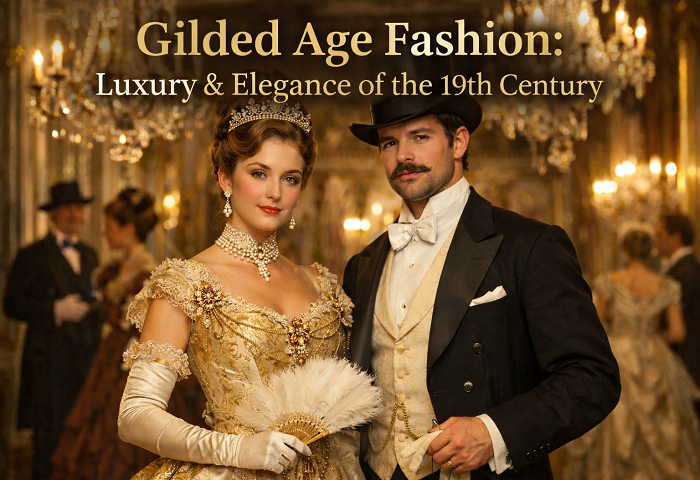
Introduction: The Era That Dressed to Impress
Between 1870 and 1900, the United States underwent one of the most dramatic social and economic transformations in its history. Factories roared. Railroads stitched the nation together. Fortunes were built in steel, oil, and banking almost overnight. And right alongside that explosion of wealth came something just as spectacular — gilded age fashion.
Gilded age fashion was not merely about clothing. It was a declaration. A performance. A carefully constructed language spoken in silk, velvet, and gold thread. The way a woman laced her corset, the cut of a man’s frock coat, or the particular angle of a feathered hat communicated social standing, ambition, and cultural sophistication to anyone who passed on the street or entered a ballroom. Every ruffle, every bustle, every embroidered glove had meaning.
This era took its name from Mark Twain and Charles Dudley Warner’s 1873 novel The Gilded Age, which satirized the superficial glitter covering deep social inequality. That contrast — dazzling surface, troubled depths — was nowhere more visible than in its clothing. The wealthy commissioned extraordinary wardrobes while the working class scraped together what they could. Yet gilded age fashion, in both its grandeur and its everyday forms, tells a remarkably complete story about American life in the late nineteenth century.
This guide takes you deep into that world: the silhouettes, the fabrics, the accessories, the designers, and the social rituals that made gilded age fashion one of the most fascinating chapters in the history of dress.
The Social Context Behind Gilded Age Fashion
To truly appreciate gilded age fashion, you must first understand the social landscape that produced it. The post-Civil War decades created a new American aristocracy — the so-called “robber barons” and their families — who had enormous wealth but, in many cases, no inherited title or old-world prestige. Fashion became their primary tool for legitimacy.
This class of new money urgently needed to demonstrate that they belonged among the cultured elite. They built palatial mansions, threw legendary balls, and most visibly, they dressed extravagantly. Gilded age fashion was driven by what sociologist Thorstein Veblen famously called “conspicuous consumption” — spending lavishly not out of necessity but to signal status to others.
The social season governed everything. From autumn through spring, elite families in New York, Newport, Boston, and Chicago moved through a relentless calendar of dinners, operas, cotillions, and charity events. Each occasion demanded a different outfit. A proper society woman might need a morning dress, an afternoon visiting costume, a tea gown, a dinner dress, and an evening ball gown — all in a single week. Gilded age fashion was therefore not just about individual garments but about mastering an entire system of dress codes.
At the apex of this system sat figures like Caroline Astor, whose approval could make or break a family’s social standing. The “Four Hundred” — the number of guests who could fit in Mrs. Astor’s ballroom and, by extension, the limit of New York’s true social elite — set the tone for gilded age fashion nationwide. What was worn at Astor balls quickly rippled outward to aspiring households across the country.
Women’s Silhouettes: The Architecture of Gilded Age Fashion
If gilded age fashion has a single defining image, it is the elaborately constructed female silhouette. Women’s dress during this period was essentially architecture — built around an armature of undergarments that shaped the body into whatever idealized form the era demanded.
The Bustle Era (1870–1890)
The bustle is perhaps the single most iconic element of gilded age fashion. This padded or wireframe structure was worn beneath the skirt at the back of the body, creating an exaggerated protrusion that could be quite dramatic by the early 1880s. The bustle went through two distinct phases.
In the first bustle period (roughly 1869–1876), skirts were drawn back and upward, creating a soft gathering and a gentle curve behind the hips. The silhouette was relatively graceful, with emphasis on intricate surface decoration — pleating, ruffling, and applied trim — across the skirt’s back.
Then came what fashion historians call the “second bustle” period, from around 1880 to 1890, and this was when gilded age fashion truly reached its most theatrical extreme. Bustles grew enormous. The shelf-like protrusion at the back was rigid and angular, supported by steel or cane frameworks. Dresses featured elaborate trains, multiple layers of fabric in contrasting colors and textures, and staggering quantities of decorative trim. To stand in a second-bustle gown was to command space in a room.
The Natural Form and Gibson Girl (1890s)
As the 1890s arrived, gilded age fashion shifted dramatically. The bustle collapsed — literally, as the frames were abandoned — and a new silhouette emerged. Skirts became full and bell-shaped, flaring from the hips downward to a wide, sweeping hem. Sleeves, meanwhile, exploded upward and outward in the famous “leg-of-mutton” or gigot style, creating enormous puffed upper arms that narrowed to a fitted wrist.
This new look aligned with the emerging “Gibson Girl” ideal created by illustrator Charles Dana Gibson. The Gibson Girl of gilded age fashion was tall, confident, and athletic-looking — a modern woman who played tennis and rode bicycles while still maintaining an impossibly cinched waist. The S-curve corset of the late 1890s thrust the chest forward and the hips back, producing a posture that was simultaneously elegant and physically demanding.
Throughout all these silhouette changes, one element of gilded age fashion remained constant: the corset. Tightly laced and structurally essential, the corset defined the waist at all times. Women of the elite class began corseting in adolescence and often achieved waists of sixteen to eighteen inches. The corset was controversial even in its day, with dress reform advocates arguing against it, but it remained central to the gilded age fashion system until well into the Edwardian era.
Fabrics and Materials in Gilded Age Fashion
The fabrics used in gilded age fashion were as spectacular as the silhouettes they created. Wealth in this era was directly expressed through material quality and quantity.
Silk was the queen of gilded age fashion fabrics. Taffeta, satin, moire, faille, brocade, and velvet — all silk-based — appeared in the most prestigious gowns. The rustling sound of silk taffeta as a woman walked was itself considered part of the fashionable effect; it was called the frou-frou, and it was desirable.
Wool played a critical role in everyday and tailored gilded age fashion. Fine wools like cashmere and merino made day dresses and walking suits that were practical without sacrificing elegance. By the 1890s, women’s tailored wool suits — jacket and skirt — had become an important fixture of gilded age fashion for active, professional, or middle-class women.
Lace was one of the most valuable elements in any gilded age fashion wardrobe. Handmade bobbin lace from Brussels, Bruges, and Honiton could cost extraordinary sums. Lace appeared as trim, as entire bodice panels, as sleeves, and as collar and cuff sets. Owning fine antique lace was a sign of old family wealth; displaying it was a quiet but powerful social statement.
Cotton and linen served more modest functions in gilded age fashion — underlayers, summer dresses, and everyday working garments for women outside the wealthy class. Yet even middle-class gilded age fashion made use of fine cotton lawn and organdy for summer afternoon dresses and blouses.
Jet, beading, and embroidery added dimension and light to gilded age fashion garments. Evening gowns were frequently encrusted with thousands of glass beads, steel bugle beads, or genuine jet. Silk embroidery — sometimes done by hand, increasingly by machine — created elaborate floral and geometric patterns across bodice yokes and skirt panels.
Men’s Gilded Age Fashion: Sober Power
Men’s gilded age fashion operated on entirely different principles than women’s. Where women’s dress was elaborate and decorative, men’s dress aimed for restrained authority. The well-dressed man of the gilded age communicated power through the quality of his cloth, the precision of his tailoring, and the subtle coordination of his accessories — never through ostentation.
The frock coat was the dominant garment of formal daytime gilded age fashion for men. Cut to the knee, with matching waistcoat and trousers, the frock coat in black or charcoal wool projected gravitas and respectability. Business leaders, politicians, and professional men wore it to offices, to social calls, and to public events throughout the 1870s and 1880s.
The morning coat — cut away in front with tails in the back — gradually replaced the frock coat as the fashionable choice for formal daytime occasions in the 1890s, a shift that reflects how even men’s gilded age fashion evolved across the decades.
For evening, men wore the tailcoat — white waistcoat, white tie, white gloves — to formal dinners and balls. This was the unquestioned uniform of gilded age fashion for men at elite social events, and deviation from it was socially unacceptable in the highest circles.
The lounge suit, or sack suit — a matching jacket, waistcoat, and trousers of less rigid construction — was emerging during the gilded age as an option for business and informal occasions. By the 1890s it was increasingly common, signaling the beginning of the modern suit’s dominance.
Men’s gilded age fashion accessories included silk top hats, leather gloves, pocket watches with elaborate gold chains, highly polished shoes, and carefully arranged neckwear — cravats, four-in-hand ties, and the wide Ascot style all had their moment in gilded age fashion. A gentleman’s cane was both practical and decorative, often topped with silver or ivory.
Children’s Gilded Age Fashion
Children of the wealthy were dressed as miniature adults in gilded age fashion, though with some notable exceptions. Young boys up to about age five wore dresses indistinguishable from girls’ styles — a common practice of the era — before transitioning to suits with knee-length breeches (called “knickerbockers”) and then to proper long trousers as they approached adolescence.
Girls’ gilded age fashion mirrored adult styles in scaled-down form: corseted bodices from around age eight or ten, full skirts with appropriate underpinnings, and elaborate trim. A key marker of girlhood in gilded age fashion was the hem length — young girls wore shorter skirts that lengthened as they aged, with the full floor-length skirt of adult women signaling the transition into womanhood.
The Role of Paris in Gilded Age Fashion
No discussion of gilded age fashion is complete without acknowledging the absolute dominance of Paris. The great French couture houses — particularly Worth, Doucet, and later Paquin — were the unchallenged authorities of elite gilded age fashion. American society women crossed the Atlantic specifically to order their wardrobes from Parisian couturiers.
Charles Frederick Worth, an Englishman who built his empire in Paris, was the single most influential designer in gilded age fashion history. Worth invented the concept of the fashion house as we know it — seasonal collections, celebrity clients, the designer’s label sewn into each garment. His house dressed empresses, queens, and the crème of American Gilded Age society. A Worth gown was the ultimate status symbol in gilded age fashion.
American women returning from Paris brought not just dresses but entire trunks of the latest silhouettes, fabrics, and accessories. New York dressmakers then copied, adapted, and reinterpreted these styles for local consumption. The fashion press — publications like Harper’s Bazar (founded 1867) and Godey’s Lady’s Book — spread Parisian gilded age fashion trends to women across the country through detailed illustrations and written descriptions.
Accessories: The Details That Defined Gilded Age Fashion
Accessories in gilded age fashion were not afterthoughts. They were integral components of a complete and carefully assembled look.
Gloves were mandatory for women in gilded age fashion at virtually every social occasion. Long kid gloves reaching above the elbow were worn with evening dress; shorter gloves for daytime. Removing gloves at dinner was a moment of social theater in itself.
Hats evolved dramatically across gilded age fashion’s span. Bonnets, which had dominated mid-century dress, gradually gave way to smaller toques and then to the wide-brimmed picture hats of the 1890s. Millinery in gilded age fashion was extraordinarily elaborate — silk flowers, ribbons, feathers, and even entire stuffed birds appeared on fashionable hats, fueling the eventually successful campaign by early conservationists to protect bird species.
Fans remained essential accessories in gilded age fashion for formal events. Made of painted silk, lace, ivory, or tortoiseshell, fans communicated through a recognized visual language of flirtatious signals in ballroom settings.
Jewelry in gilded age fashion was spectacular. The robber baron fortunes enabled extraordinary purchases — diamond parures, pearl necklaces of historical significance, sapphire and ruby suites from European royal collections. Tiffany & Co., established in New York, became the preeminent American jeweler of gilded age fashion, supplying the new aristocracy with pieces that rivaled European collections.
Parasols and umbrellas served both practical and decorative functions in gilded age fashion. A delicate silk parasol trimmed with lace fringe was a standard summer accessory for any fashionable woman.
Shoes and boots in gilded age fashion were typically pointed at the toe and high at the heel. For women, leather and fabric boots buttoning up the ankle were the daily standard, while satin slippers in matching gown colors appeared for evening. Men wore leather oxfords and boots polished to a mirror shine.
Working-Class and Middle-Class Gilded Age Fashion
Elite gilded age fashion existed alongside a much broader spectrum of dress. The rapid industrialization of the era created both the extreme wealth at the top and a vast working class at the bottom, and gilded age fashion reflected that divide clearly.
Working-class women in the gilded age wore simpler versions of fashionable silhouettes, made from less expensive fabrics — cotton, wool blends, and printed calicoes. Ready-made clothing, an industry just beginning to scale in the late nineteenth century, made basic fashionable garments increasingly accessible. Department stores like Macy’s and Marshall Field’s, themselves gilded age institutions, brought display windows full of stylish goods to middle-class shoppers.
The middle class in America navigated gilded age fashion carefully, investing in quality pieces — a good wool suit, a silk blouse for Sunday — while making do with simpler everyday garments. The sewing machine, domesticated by Singer in the 1850s and 1860s, made home dressmaking practical, and paper patterns from companies like Butterick (founded 1863) allowed women of ordinary means to replicate fashionable gilded age silhouettes at home.
This democratization of gilded age fashion was one of the era’s most significant developments. For the first time in history, middle-class women could dress in recognizably fashionable styles. The gap between elite and everyday dress remained wide, but it was narrower than it had ever been before.
Mourning Dress in Gilded Age Fashion
Victorian mourning customs produced a significant subcategory of gilded age fashion: mourning dress. The elaborate rituals of grief — with their strictly defined stages, each requiring specific garments — occupied considerable space in any upper or middle-class woman’s wardrobe.
Immediate or “full” mourning in gilded age fashion required solid black in dull, non-reflective fabrics — matte wool and silk crepe rather than shiny taffeta. No jewelry except jet. No lace. No trim of any other color. This stage lasted one year for a widow.
“Half mourning” followed, introducing grey, mauve, and white as permitted colors, and allowing the gradual return of decorative elements. By the late 1890s, mourning dress conventions were beginning to relax, but throughout most of the gilded age fashion period they remained stringent and widely observed.
Specialized mourning retailers operated in major cities, and publications gave explicit guidance on the appropriate dress for each stage of bereavement. Mourning dress in gilded age fashion was simultaneously a mark of social propriety and, for the wealthy, an opportunity to commission exquisitely made garments in a narrow but sophisticated palette.
The Decline and Legacy of Gilded Age Fashion
Gilded age fashion did not end abruptly; it transitioned. As the nineteenth century became the twentieth, the Edwardian era carried many of the gilded age’s aesthetic values forward — the elaborate millinery, the corseted silhouette, the emphasis on surface decoration — while gradually softening and lightening them. The S-curve corset gave way to a more vertical line. The leg-of-mutton sleeve deflated. Skirts simplified.
The true end of gilded age fashion came with World War I and the subsequent social revolution of the 1920s, when the corset was finally abandoned, hemlines rose, and the whole elaborate architecture of nineteenth-century dress was swept away.
But the legacy of gilded age fashion endures. It remains a source of endless fascination for costume historians, textile collectors, museum curators, and fashion designers seeking inspiration in the past. The Met Costume Institute in New York holds one of the world’s great collections of gilded age fashion pieces. Period dramas set in the late nineteenth century — from HBO’s The Gilded Age to various film adaptations of Henry James and Edith Wharton — bring the silhouettes and fabrics vividly back to life.
For contemporary designers, gilded age fashion offers an inexhaustible archive of structural innovation, decorative technique, and sheer aesthetic ambition. The bustle has reappeared on couture runways; corseted bodices are perennial favorites in eveningwear; the lush, heavy fabrics of the era continue to inspire luxury fashion houses worldwide.
Conclusion: Why Gilded Age Fashion Still Captivates
Gilded age fashion captivates us today for the same reasons it captivated contemporaries: it is unapologetically spectacular. In an era defined by extraordinary ambition — to build, to accumulate, to be seen — clothing became one of the primary arenas in which that ambition played out.
But gilded age fashion also tells a more complicated story. It reveals the tension between old money and new, between Paris and New York, between the lavish wardrobes of the wealthy and the simpler dress of those who made that wealth possible. It shows how dress functions as a social system, encoding values and hierarchies in every seam.
Whether you approach gilded age fashion through the lens of history, cultural criticism, textile craftsmanship, or pure aesthetic pleasure, you will find it endlessly rewarding. The silhouettes are extraordinary. The fabrics are sumptuous. The accessories are remarkable. And behind every carefully constructed ensemble is a human story — of ambition, of belonging, of identity — that resonates across the century and a half that separates us from that glittering, complicated world.