Introduction
Few decades left a mark on style history as loudly, proudly, and unapologetically as the nineteen eighties. Walk into any vintage shop today, scroll through TikTok for five minutes, or flip through a runway report from the last few seasons, and you will spot its fingerprints everywhere. 80’s fashion is not just a throwback — it is a living, breathing movement that keeps coming back in waves, each time a little louder than before.
In this guide, we will unpack everything that made 80’s fashion so unforgettable: the colors, the silhouettes, the icons, the music videos, the subcultures, and the reasons it still dominates moodboards in 2026. Whether you grew up with MTV on your television or you are a Gen Z reader discovering the era through reruns, this is your complete map to the boldest decade in modern style.
Why 80’s Fashion Still Matters Today
Ask any designer why 80’s fashion refuses to fade, and you will usually hear the same answer: it was the last decade when people dressed without irony. Clothes were loud because life was loud. The stock market was booming, MTV had just been born, personal computers were arriving in homes, and music was splintering into a hundred new genres. The wardrobe followed.
That confidence is exactly what modern consumers crave. In an age of quiet luxury and minimalist capsule wardrobes, 80’s fashion offers the opposite: maximum volume, maximum color, maximum personality. Every few years, a new generation rediscovers it, and the cycle repeats. Designers from Balenciaga to Saint Laurent have all pulled from eighties silhouettes in recent collections, and the streetwear scene has been obsessed with 80’s fashion for the better part of a decade.
There is also a nostalgic pull. Shows like Stranger Things and GLOW introduced a younger audience to the look, and social media did the rest. On Pinterest alone, searches for retro looks, acid wash denim, and neon outfits have climbed year over year.
The Cultural Backdrop Behind the Style
To understand 80’s fashion, you have to understand the world that produced it. The decade was shaped by several massive cultural forces, and each left its mark on what people wore.
MTV and the music video era. When MTV launched in 1981, fashion suddenly had a new and enormously powerful broadcast medium. Musicians were not just heard; they were watched. Madonna’s lace gloves, Prince’s ruffled shirts, Boy George’s layered eclecticism, and Cyndi Lauper’s kaleidoscopic outfits became style scripts that millions of teenagers copied.
Wall Street and power dressing. The business boom of the era gave us the power suit, the oversized blazer, and the shoulder pad. Films like Working Girl and Wall Street made executive dressing aspirational. Women in particular embraced strong, architectural silhouettes as a form of professional armor.
Aerobics and the fitness boom. Jane Fonda’s workout videos and the rise of aerobics studios pushed activewear into everyday outfits. Leotards, leg warmers, headbands and high-cut swimsuits moved from the gym to the street.
Punk, new wave, and hip-hop. On the other end of the spectrum, youth subcultures produced some of the most inventive looks of all. Punk gave us ripped denim, safety pins and leather. New wave added geometry, asymmetry, and black eyeliner. Early hip-hop introduced tracksuits, bucket hats, gold chains, and fresh white sneakers — a foundation that still shapes streetwear today.
Key Trends That Defined 80’s Fashion
Now let’s get into the details. These are the looks that, even four decades later, instantly signal the era.
Neon Colors and Bold Prints
Nothing says 80’s fashion faster than a hit of electric pink, neon yellow, or cyan blue. The decade abandoned the earth tones of the seventies and went straight into fluorescent territory. Designers paired shocking colors with clashing prints — animal, geometric, abstract, all at once. A typical outfit might combine a neon windbreaker with patterned leggings, a white tee, and scrunchie socks.
Shoulder Pads and Power Suits
The shoulder pad is probably the single most recognizable silhouette of the era. Women wore them in blazers, dresses, knitwear, and even t-shirts. The look created a strong, inverted triangle shape that projected authority. Designers like Giorgio Armani and Thierry Mugler elevated the power suit to high fashion, while brands such as Donna Karan made it accessible. Any conversation about 80’s fashion has to start with the shoulder.
Denim Everything
Denim was not a single item in the eighties; it was a lifestyle. Acid wash, stone wash, stirrup jeans, high-waisted cuts, denim jackets, denim skirts, denim on denim — the fabric was everywhere. Brands like Guess, Jordache, Levi’s 501, and Calvin Klein Jeans built cultural empires during this decade. Acid wash in particular is one of the most iconic textures of the decade, instantly readable the moment it appears.
Leg Warmers and Activewear
Thanks to films like Flashdance and the aerobics craze, leg warmers, leotards, sweatbands and cropped sweatshirts became part of daily wardrobes, not just gym kits. A woman might pair a ballet-neck sweatshirt pulled off one shoulder with leggings and slouchy leg warmers for a casual weekend look. This is one of the most copied formulas of the era today, popular both on runways and in everyday streetwear.
Parachute Pants and Baggy Silhouettes
The top half may have been structured, but the bottom half often went the opposite way. Parachute pants, made of shiny synthetic fabric with zippers and snap details, exploded thanks to breakdance culture and artists like MC Hammer. Baggy trousers, pleated chinos, and drop-crotch styles all came from this moment.
Punk, Goth, and New Wave
On the alternative side, the decade got darker and sharper. Leather jackets covered in studs, fishnet tights, combat boots, chunky crucifixes, teased black hair and heavy eyeliner became uniforms in clubs from London to Los Angeles. Bands like The Cure, Depeche Mode, and Siouxsie and the Banshees shaped the aesthetic of an entire subculture.
Preppy Style
At the other pole was preppy. Polo shirts with popped collars, argyle sweaters, loafers, pearls, and pastel cardigans — the look of The Preppy Handbook (1980). Brands such as Ralph Lauren, Lacoste, and Tommy Hilfiger thrived on this aesthetic, and preppy style remains one of the most enduring branches of 80’s fashion.
Iconic Style Icons of the Decade
Every era has its faces, and the eighties produced more style icons than almost any other decade.
Madonna
If there is one person synonymous with the eighties look, it is Madonna. Her early look — lace gloves, rosary beads, tulle skirts, mesh tops, giant cross earrings — launched a million teenage wardrobes. The “Material Girl” and “Like a Virgin” eras alone generated enough inspiration for decades of stylists.
Princess Diana
On a completely different end of the spectrum, Princess Diana made tailored jackets, pie-crust collars, puff-sleeve blouses, and preppy knitwear aspirational. Her off-duty looks — high-waisted jeans, Virgin Atlantic sweatshirts, and cycling shorts with oversized blazers — are probably the most referenced real-person outfits in recent fashion history.
Michael Jackson and Prince
The two great musical rivals of the decade also defined male 80’s fashion. Michael Jackson’s red leather Thriller jacket, single white sequin glove, and high-water pants became an instant global uniform. Prince took the opposite route — ruffled shirts, purple velvet, eyeliner, high-heeled boots, and an unmistakable theatricality.
The Brat Pack
Molly Ringwald’s lace and pastel looks in Pretty in Pink, Andrew McCarthy’s preppy sweaters, and Judd Nelson’s denim-and-leather rebellion in The Breakfast Club made teen movies the most influential style guides of the decade.
Grace Jones
For anyone interested in the more avant-garde edge of 80’s fashion, Grace Jones remains essential viewing. Her collaborations with Jean-Paul Goude produced some of the most striking, architectural, sculptural looks ever photographed — flat-tops, sharp tailoring, geometry, and a total rejection of traditional femininity.
80’s Fashion for Men
Men’s wardrobes in the eighties were more experimental than any decade before or since. Here are the staples.
Oversized blazers. Usually double-breasted, often in pastel linen, sometimes with the sleeves rolled up (thank you, Miami Vice). Pair them with a t-shirt and loafers, no socks.
Members Only jackets. The iconic thin racer jacket with epaulettes and a buttoned collar was the unofficial uniform of suburban teenagers. Few pieces are more characteristic of 80’s fashion for men than this one.
Tracksuits. From Adidas to Fila to Sergio Tacchini, the tracksuit went from sports kit to street staple, especially in early hip-hop.
Hawaiian shirts. Largely thanks to Magnum P.I. and the Miami aesthetic, loud floral shirts became acceptable at beach parties, bars, and weekend brunches.
High-top sneakers. Reebok Freestyles, Nike Air Jordans, and Converse Weapons all launched or peaked in this era. Sneakers became serious fashion objects, often laced loosely with fat tongues flopping forward.
Stone-washed jeans. Light blue, slightly baggy, sometimes cuffed. Paired with a white tee and a leather belt, this was the everyman look of the decade.
80’s Fashion for Women
Women’s wardrobes had even more range, spanning boardroom power dressing to rebel clubwear.
The power suit. A tailored blazer with pronounced shoulders, a pencil skirt or wide-leg trouser, a silk blouse with a pussy bow, and pumps. Crisp, commanding, and unforgettable.
Puff-sleeve dresses. Laura Ashley-style romantic dresses with ruffles, bows, and floral prints — popular for weddings, proms, and Sunday church.
Mini skirts and bodycon. Azzedine Alaïa’s body-hugging silhouettes, paired with opaque tights and ankle boots, were the late-decade clubbing uniform.
Crop tops and sweatshirts. Off-shoulder cuts, bold slogans, and deliberate oversizing created the casual side of 80’s fashion, much of it inspired by the fitness boom.
Jumpsuits and catsuits. Often in shiny fabrics, worn with a belt and statement earrings, jumpsuits were a go-anywhere solution to evening dressing.
Bold accessories. Giant hoops, plastic bangles, scrunchies, jelly bracelets, fanny packs, and rhinestone belts all played a role. More was always more.
Hairstyles and Beauty: The Full Look
You cannot talk about 80’s fashion without talking about the hair. Volume was the single most important rule. Perms, mousse, hairspray, crimping irons, and side ponytails created the towering, teased shapes the decade is remembered for. Mullets were mainstream. Bleached blondes, asymmetric cuts, and neon streaks pushed the avant-garde edge.
Makeup followed the same maximalist logic: blue eyeshadow up to the brows, pink or coral blush, glossy lips, and thick brows (Brooke Shields essentially redefined the brow). Perfume was dramatic — Giorgio Beverly Hills, Poison by Dior, and Obsession by Calvin Klein filled every elevator.
Streetwear, Sportswear and the Birth of Sneaker Culture
One of the most underrated legacies of 80’s fashion is the birth of modern streetwear. The collision of hip-hop, skateboarding, surf culture, and sports marketing during this decade created the blueprint for everything that came after — from Supreme to Off-White.
Run-DMC’s partnership with Adidas, the Air Jordan launch in 1985, the arrival of Stüssy, and the explosion of skate brands like Vision Street Wear all happened within a few years. Tracksuits, bucket hats, logo tees, and chunky sneakers became permanent additions to the global wardrobe. Many of the most expensive resale sneakers sold today were first released during this era.
What made this moment different was how quickly the lines between sport, music, and style dissolved. A basketball shoe could become a nightclub staple within months. A rapper’s outfit could trigger a brand’s biggest sales quarter. A skateboarding teenager in Venice Beach could influence what a kid in Tokyo wore the following summer, simply because a magazine photographer happened to capture the moment. This was before the internet, and yet the feedback loop was already incredibly fast — largely because MTV, magazines, and a new generation of stylists were all pulling in the same direction.
The legacy is everywhere. When you see a hyped sneaker drop in 2026, a graphic tee selling for four figures, or a streetwear brand collaborating with a luxury house, you are watching an idea that was born in the eighties. Every element of hypebeast culture — the logo worship, the limited drops, the crossover between music and clothing — has its roots in 80’s fashion.
Accessories That Defined the Decade
Accessories in 80’s fashion were not a finishing touch; they were often the whole outfit. Some of the most recognizable pieces include:
- Giant plastic earrings in geometric shapes
- Neon belts and suspenders
- Banana clips and scrunchies
- Swatch watches, often stacked two or three at a time
- Ray-Ban Wayfarers, made famous by Tom Cruise in Risky Business
- Fingerless lace gloves
- Jelly shoes and jelly bracelets
- Layered pearls worn over t-shirts
- Fanny packs, slung across the hip rather than the waist
- Aviator sunglasses and mirrored lenses
Even in 2026, most of these items are easy to find on resale apps, and they add instant retro character to a modern outfit.
Subcultures That Shaped the Era
Beyond the mainstream, a handful of subcultures produced some of the most creative expressions of 80’s fashion.
Goth. Black lace, velvet, crucifixes, fishnets, Dr. Martens boots. Inspired by bands like Bauhaus and The Sisters of Mercy.
New Romantic. Frilled shirts, pirate boots, eyeliner on men, pirate blouses, sashes. Boy George and Duran Duran were its avatars.
Hip-hop. Tracksuits, Kangol hats, shell-toe Adidas, gold chains, door-knocker earrings. A look that literally built an industry.
Preppy. Polo shirts, penny loafers, argyle socks. Classic, Ivy-influenced, and still alive today.
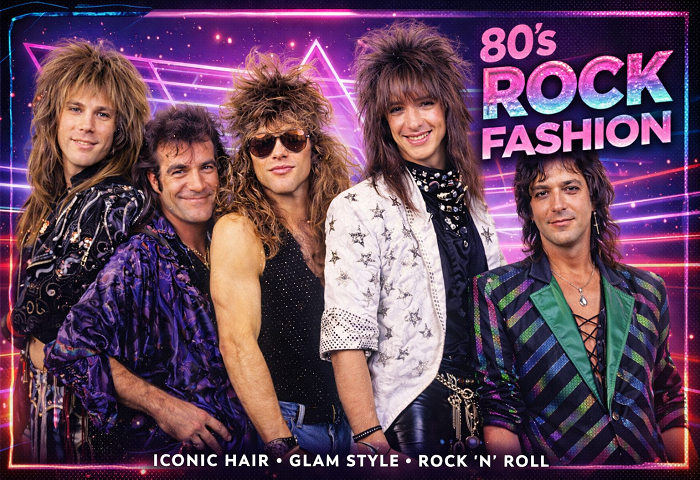
Hair metal. Spandex pants, bandanas, teased hair, leather vests. Los Angeles’s Sunset Strip was the epicenter.
Each of these tribes contributed something permanent to the global vocabulary of 80’s fashion.
How to Wear 80’s Fashion Today
Here’s where it gets fun. You do not need a time machine to work this aesthetic into your wardrobe — you just need to pick your pieces carefully and mix them with modern basics.
Start with one hero piece. An acid-wash denim jacket, a pair of high-waisted jeans, or a slouchy shoulder-padded blazer is enough to anchor a whole outfit. Keep the rest neutral.
Use color as an accent. Instead of an entire neon outfit, try a neon belt, earrings, or socks. The impact is still there, but it feels contemporary.
Re-proportion the silhouette. Eighties volume sits on top with slim bottoms or slim on top with slouchy bottoms. Avoid volume on both halves unless you want full costume energy.
Play with accessories. Scrunchies, chunky gold hoops, Ray-Bans, and Swatch watches are inexpensive, easy entry points.
Add a modern sneaker. Pair a retro skirt or tracksuit with a clean white sneaker so the outfit reads 2026 rather than 1986.
Balance your hair and makeup. If the outfit is loud, keep the hair sleek. If you are going for big hair, dial the outfit back. This is the secret to wearable 80’s fashion today.
Sustainable Style: The Vintage Angle
There is one more reason 80’s fashion keeps coming back: sustainability. As younger consumers move away from fast fashion, vintage eighties pieces are suddenly some of the most sought-after items in the resale market. Shopping a forty-year-old denim jacket is cheaper, more original, and far kinder to the planet than buying a new one from a chain store.
Resale platforms have reported sustained growth in searches for terms like “vintage Levi’s,” “acid wash,” “Members Only,” and “80s blazer.” Thrift stores in major cities have started curating dedicated eighties sections, and many independent sellers now specialize almost exclusively in this era. The quality is often superior, too — jeans from the eighties were frequently made with heavier denim, and tailoring from the decade tends to be more substantial than comparable modern pieces at the same price point.
If you care about the environment, your wallet, or simply standing out, building a wardrobe around genuine vintage pieces from this era is one of the smartest moves you can make today. Even a single authentic find — a worn-in leather jacket, a beaded evening top, or a printed silk shirt — can become the centerpiece of dozens of outfits.
Where to Shop
Finding great pieces is easier than ever. Platforms like Depop, Vinted, Etsy, and eBay are full of authentic eighties finds. Brands such as Levi’s, Guess, Tommy Hilfiger, and Adidas have leaned into re-releases and archive drops. High-street retailers like Zara, H&M, and ASOS regularly put out 80’s-inspired capsule collections.
For investment pieces, look at vintage Alaïa, Versace, Mugler, Montana, and Comme des Garçons — all of which produced some of the most groundbreaking 80’s fashion of the decade and are now highly collectible.
FAQs About 80’s Fashion
1. What are the main characteristics of 80’s fashion? Bold colors, strong shoulders, layered textures, acid-wash denim, leg warmers, oversized silhouettes, loud prints, and lots of accessories. Maximalism is the guiding principle.
2. What is the most popular 80’s fashion trend today? High-waisted jeans, oversized blazers, scrunchies, and chunky gold jewelry are among the most-revived looks in 2026. Windbreakers and varsity jackets are also back in a big way.
3. How can I dress in 80’s fashion without looking like a costume? Stick to one or two retro pieces per outfit and pair them with modern basics. A shoulder-padded blazer with a plain tee and straight jeans reads chic; the same blazer with leggings and leg warmers reads Halloween.
4. Was 80’s fashion different for men and women? Yes, but both genders embraced bold silhouettes and loud colors. Men favored oversized blazers, Hawaiian shirts, and high-top sneakers, while women leaned into power suits, puff-sleeve dresses, and jumpsuits.
5. Why is 80’s fashion so popular again? Nostalgia, television shows set in the era, runway revivals, and the Gen Z love of vintage have all pushed the look back to the front. In a minimalist fashion landscape, the boldness and color of 80’s fashion feels refreshing.
6. What shoes go best with 80’s fashion outfits? High-top sneakers, white leather trainers, ankle boots, pumps with pointed toes, jelly shoes, and cowboy boots all work depending on the outfit’s direction.
Final Thoughts
The eighties were loud, colorful, confident, and a little ridiculous — and that is exactly why they keep coming back. Every generation finds something new to love in the era, whether it is Princess Diana’s tailoring, Madonna’s layered rebellion, hip-hop’s sneaker obsession, or the avant-garde genius of designers like Alaïa and Mugler.
If you are building a wardrobe in 2026 and looking for ways to stand out, borrowing from 80’s fashion is one of the easiest and most rewarding routes. Pick your pieces with intention, mix them with modern staples, and do not be afraid of color. At its heart, the lesson of the decade is simple: clothes should be fun. And that is a message worth keeping, no matter what year it is.