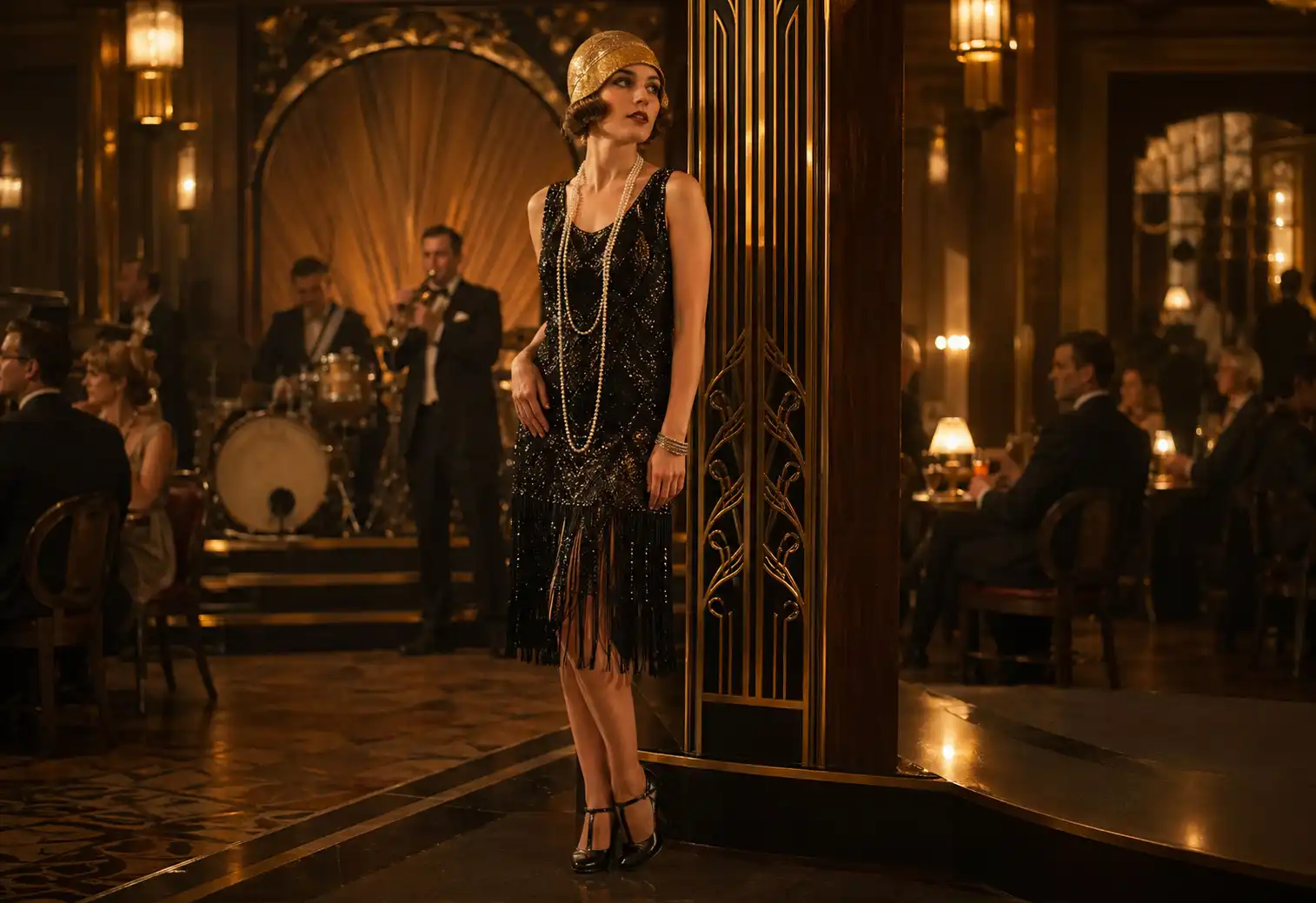
Introduction
The roaring 20s fashion era gave women the boldest wardrobe shift in modern history. This guide covers every major style, silhouette, and accessory from the 1920s decade so you can understand the era fully or recreate it today.
Quick Answer: Roaring 20s fashion is defined by dropped-waist flapper dresses, short hemlines, boyish silhouettes, Art Deco beading, cloche hats, T-strap heels, and long pearl necklaces. Women abandoned corsets for loose, straight-cut dresses. Men wore wide-leg Oxford bags, double-breasted suits, and two-tone spectator shoes.
What Defined Roaring 20s Fashion?
Roaring 20s fashion broke every rule that came before it. The rigid, corseted Edwardian silhouette disappeared almost overnight after World War I ended in 1918.
Women entered the workforce in large numbers. That social shift demanded practical, comfortable clothing. The flapper dress became the symbol of that freedom.
Roaring 20s fashion sat on a straight, tubular silhouette. The waistline dropped to the hip. Hemlines climbed from the floor to just below the knee. Suddenly, showing legs was acceptable in public.
The complete shift in women’s dress silhouettes during the 20th century started with this decade’s radical changes.
The Flapper Dress: The Icon of the Era
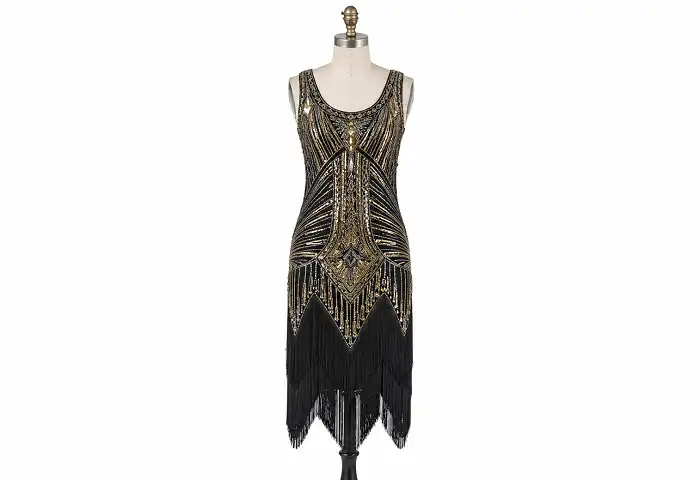
The flapper dress is the single most recognizable piece of roaring 20s fashion. It featured a loose, straight cut with no defined waist.
Designers used chiffon, silk, velvet, and crepe as primary fabrics. Beading, fringe, and sequins added movement on the dance floor.
Fringe was especially popular because it swayed with every Charleston step. Art Deco geometric patterns appeared across necklines, hemlines, and sleeves.
Short sleeves or sleeveless cuts were common. Low necklines in the back became fashionable for evening wear.
Key Women’s Clothing Pieces in the 1920s
Roaring 20s fashion for women went beyond the flapper dress. Here are the core wardrobe staples:
Day dresses used cotton or wool in muted tones. They had simple dropped waists and modest hemlines around the calf.
Evening gowns featured heavy beading, metallic thread, and dramatic back cutouts. These were the showstoppers at jazz clubs and speakeasies.
The chemise replaced the structured blouse. It sat loose against the body and layered easily under jackets.
Fur-trimmed coats were a luxury statement. Women wore long coats with wide lapels and belted waists over their flapper dresses in cooler months.
Sportswear entered women’s fashion for the first time in a serious way. Tennis whites, knit cardigans, and pleated skirts became acceptable casual wear, largely influenced by designer Coco Chanel, whose jersey fabrics redefined comfort dressing.
Roaring 20s Fashion Accessories
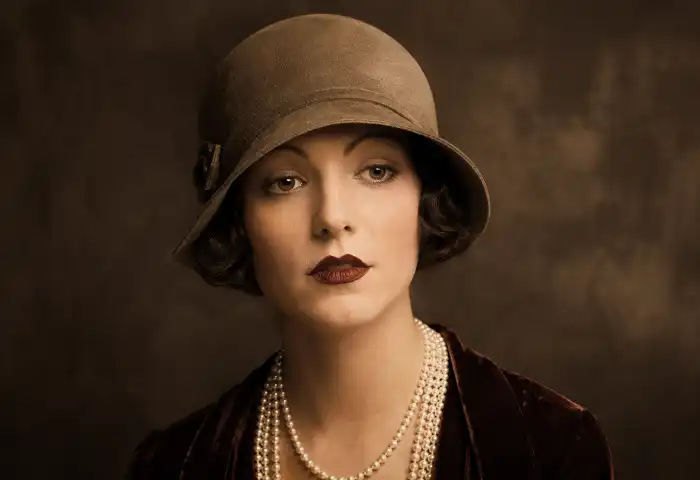
Accessories defined the roaring 20s fashion look as much as the clothing itself.
Cloche hats sat low over the forehead, almost covering the eyes. They worked because the new short bob haircut let them fit snugly.
Long pearl necklaces layered multiple strands and hung to the waist. They swayed during dancing and became a symbol of the modern woman.
T-strap and Mary Jane heels were the standard shoe. Cuban heels in black or two-tone leather were practical for dancing.
Elbow-length gloves appeared at formal events. Silk or satin versions paired with sleeveless evening gowns.
Beaded evening bags replaced large handbags. Small rectangular clutches carried only the essentials.
Feather boas and headbands with Art Deco brooches completed evening outfits. The headband wrapped around the forehead and sat just above the eyebrows.
Men’s Roaring 20s Fashion
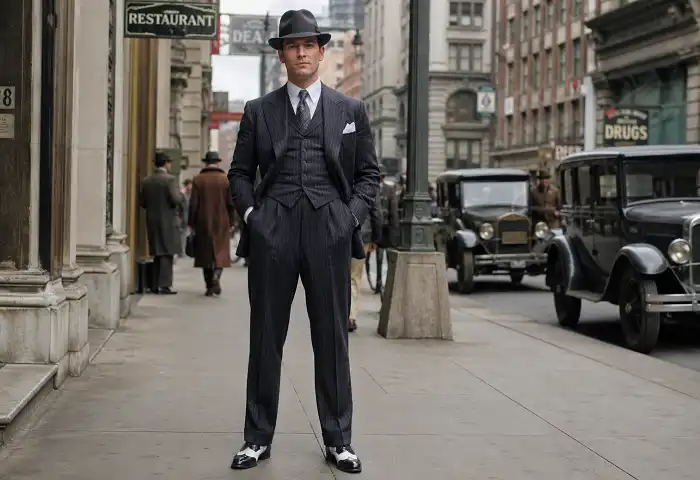
Roaring 20s fashion for men moved away from the stiff, formal Edwardian look toward something more relaxed and expressive.
The lounge suit replaced the frock coat as everyday formal wear. Men wore three-piece suits with wide lapels and high-waisted trousers.
Oxford bags were the defining trouser silhouette. These extremely wide-leg trousers became popular on college campuses in England and spread quickly.
The double-breasted suit appeared in evening settings. Pinstripe fabric in navy, charcoal, or grey was standard.
Two-tone spectator shoes in black-and-white or brown-and-white were the statement footwear for men.
The newsboy cap and fedora were daily headwear. The fedora became associated with both businessmen and jazz musicians.
Knitwear gained acceptance for casual occasions. Argyle sweaters and V-neck pullovers were popular among younger men.
The evolution of men’s suiting through the decades shares a line directly from the retro style choices that followed decades later.
Hair and Makeup in the 1920s
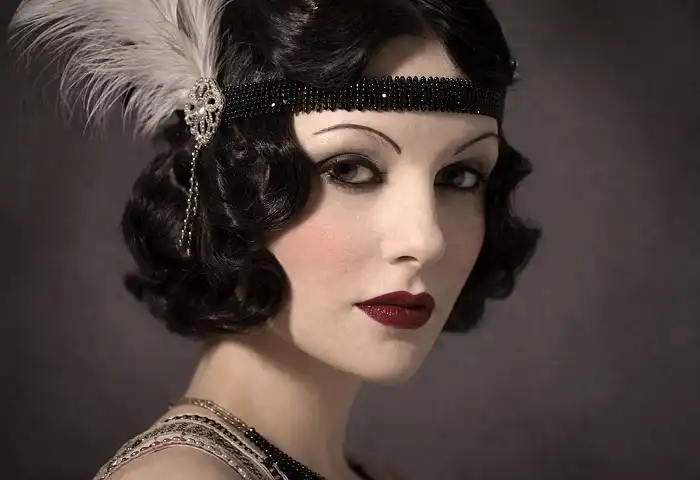
Roaring 20s fashion extended fully into grooming and beauty.
The bob haircut was the decade’s defining hairstyle. Women cut their long hair short, sometimes adding finger waves or Marcel waves for texture.
The Eton crop went even shorter, shaved close at the nape. It was considered the most radical style choice of the era.
Makeup shifted dramatically. Women began wearing dark kohl eyeliner, deep red lip color, and heavily powdered pale skin. This was a public act — wearing makeup visibly was itself a social statement.
Eyebrows were plucked thin and drawn as narrow arched lines. Combined with the cupid’s bow lip, this created the era’s signature face.
Fabrics and Colors in Roaring 20s Fashion
Fabric choice shaped the whole movement. Roaring 20s fashion relied on materials that moved, reflected light, and felt comfortable without structure.
Silk charmeuse draped smoothly and caught lamplight beautifully. It was the first choice for eveningwear.
Georgette and chiffon layered for a lightweight, flowy effect.
Velvet appeared in jewel tones: emerald, sapphire, and burgundy. It was the luxury fabric choice for winter evening gowns.
Gold and silver lamé brought metallic shine to evening dresses. This matched the Art Deco love of geometric glitter.
Color palettes ranged from neutral creams and blushes in daywear to deep jewel tones and metallics at night. Black became fashionable for women’s daywear for the first time, partly due to Chanel’s influence.
Art Deco’s Influence on 1920s Style
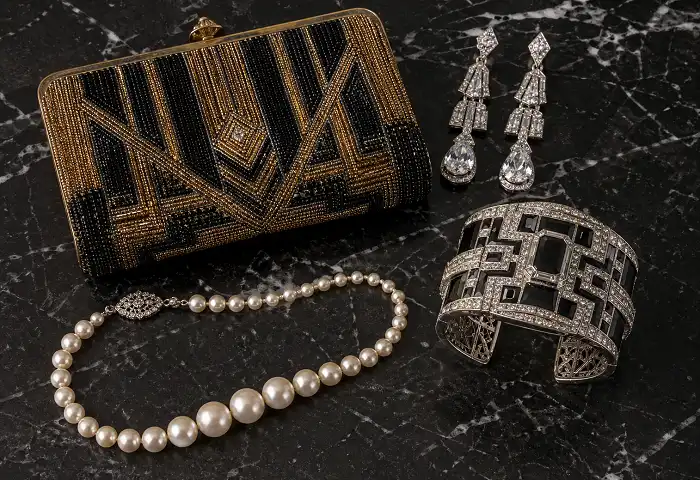
Art Deco was the visual language of roaring 20s fashion. The design movement ran from roughly 1920 through the early 1940s and touched every category of design.
In clothing, Art Deco meant geometric patterns, sunburst motifs, zigzag beading, and bold angular embroidery.
Jewelry featured platinum settings with diamonds, onyx, and coral arranged in symmetrical patterns. Long drop earrings and wide cuff bracelets carried these geometric forms.
Art Deco inspired everything from the shape of belt buckles to the pattern on evening bags. It gave the entire decade a unified visual identity.
The Smithsonian’s fashion history resources document how Art Deco aesthetics embedded themselves across American dress culture during the period.
The Social Context Behind the Style
Roaring 20s fashion did not appear randomly. It reflected specific social changes happening in real time.
Prohibition pushed nightlife underground into speakeasies. Jazz music filled those spaces. Dancing became the central social activity. Clothing had to move.
Women’s suffrage in the US passed in 1920. That political power translated into personal expression through dress.
Hollywood spread styles nationally through silent films. Actresses like Clara Bow and Louise Brooks became style icons whose wardrobes ordinary women copied.
Economic prosperity in the mid-1920s gave the middle class more disposable income. Department stores made fashion accessible beyond the wealthy.
How to Recreate Roaring 20s Fashion Today
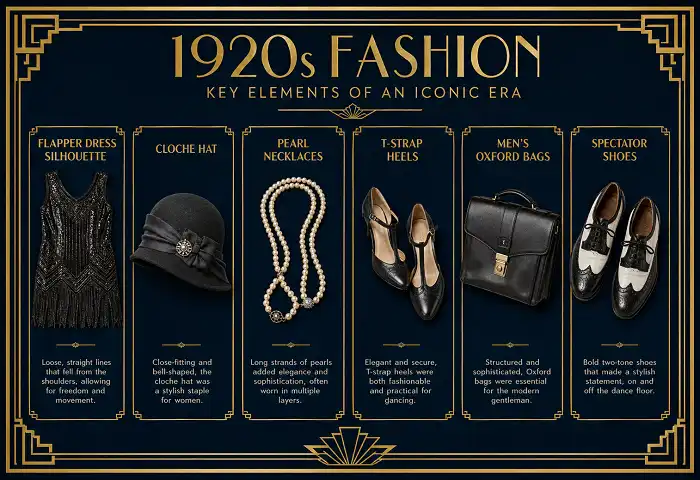
Roaring 20s fashion translates well to modern costume and themed events. Here is how to build the look correctly.
For women:
- Start with a straight, dropped-waist dress in black, gold, or deep jewel tones.
- Add fringe or beading if the dress doesn’t already have it.
- Wear a cloche hat or a beaded headband low on the forehead.
- Layer long pearl necklaces in multiple strands.
- Choose T-strap heels in black or nude.
- Apply dark red lipstick and thin drawn-on eyebrows.
- Style hair in a bob or finger waves.
For men:
- Wear a three-piece suit in charcoal, navy, or pinstripe.
- Choose wide-leg trousers if you want the full authentic silhouette.
- Add two-tone spectator shoes or classic Oxford lace-ups.
- Wear a fedora or newsboy cap.
- Add a pocket square and a tie bar for detail.
Themed 1920s parties, Great Gatsby events, and Halloween call for this look consistently. Getting the silhouette right matters more than any individual piece.
Common Mistakes When Styling the 1920s Look
These are the most frequent errors people make when recreating roaring 20s fashion.
Using the wrong silhouette. The 20s dress is straight and loose. A fitted or flared dress belongs to a different decade.
Placing the waist too high. The dropped waist sits at the hip, not the natural waist.
Choosing the wrong shoe. Stilettos and platform heels are modern. T-straps and Mary Janes keep the look period-correct.
Overdoing the accessories. The look is layered but intentional. One statement piece at a time: either the headband or the feather boa, not both.
Using the wrong makeup base. The 1920s look uses pale, powdered skin. Heavy bronzer pulls the look into a different era entirely.
Roaring 20s Fashion vs. Other Decades
Roaring 20s fashion sits distinctly between the structured Edwardian era and the fitted, waist-defining 1930s and 1940s looks.
The 1910s were corseted and formal. The 1930s brought bias-cut gowns that emphasized curves again. The 1920s sits in between as the one decade where the female silhouette was deliberately non-curvy.
That makes it unique. No other mainstream fashion decade deliberately flattened and straightened the female form as a style goal.
The contrast becomes even clearer when you compare it to the structured glamour of the 1940s era or the nipped-waist looks of the 1950s.
Notable Designers of Roaring 20s Fashion
Several designers defined roaring 20s fashion and shaped the silhouette for the whole decade.
Coco Chanel introduced jersey fabric, the little black dress concept, and simple, practical luxury. Her work made comfort stylish.
Paul Poiret had dominated pre-war fashion but struggled to adapt. He did introduce harem pants and looser Eastern-inspired silhouettes that influenced the decade’s preference for soft draping.
Madeleine Vionnet pioneered the bias cut, which would fully emerge in the 1930s but appeared in experimental pieces during the late 1920s.
Jeanne Lanvin kept a romantic aesthetic but updated it with Art Deco detailing and robes de style that offered an alternative to the flapper silhouette.
Roaring 20s Fashion in Pop Culture
The Great Gatsby — both the 1974 and 2013 film versions — brought roaring 20s fashion back into mainstream consciousness.
The 2013 film used Prada and Miu Miu alongside designer pieces from the era to recreate the look. Costume designer Catherine Martin worked with Miuccia Prada directly. The film sparked a global 1920s fashion revival.
Downton Abbey’s 1920s seasons showed everyday roaring 20s fashion, not just party wear. That series gave the decade a more complete visual treatment.
Any time a Great Gatsby party trend rises, searches for roaring 20s fashion spikes. The decade has permanent pop culture relevance.
Conclusion
Roaring 20s fashion gave the world its first real look at women dressing for themselves. The flapper dress, cloche hat, dropped waist, short hem, and Art Deco accessories all added up to a visual revolution.
The decade’s style came from real social change — jazz, suffrage, prohibition, and economic growth all fed into what people wore. That is why it still resonates. Understanding roaring 20s fashion means understanding a moment when everything shifted at once.