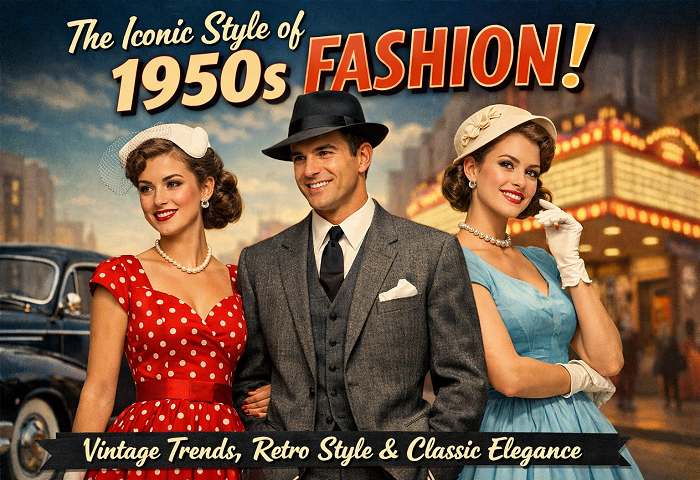
Introduction: Why This Era Still Captures Our Hearts
There is something undeniably magnetic about 1950s fashion. Decades have passed, trends have risen and fallen, and entire style revolutions have come and gone — yet the silhouettes, fabrics, and spirit of postwar American and European dressing continue to inspire runways, costume departments, and everyday wardrobes around the world. From the swooping volume of a circle skirt to the sharp precision of a tailored blazer, this era represented a cultural moment that was as bold and optimistic as it was elegantly restrained.
To truly understand why 1950s fashion matters, you have to understand the world it was born into. After years of wartime rationing, fabric restrictions, and somber utility dressing, the late 1940s and early 1950s brought an explosion of color, volume, and femininity. Designers, manufacturers, and everyday women were hungry for beauty again — and the fashion world delivered in spectacular style.
This guide takes a comprehensive dive into the defining elements of this beloved era, exploring everything from women’s silhouettes and iconic accessories to men’s style and the rebellious subcultures that pushed back against mainstream glamour. Whether you are a vintage fashion enthusiast, a costume designer, or simply someone curious about style history, there is something here for everyone.
The New Look: How Christian Dior Changed Everything
No discussion of mid-century style can begin without acknowledging the seismic shift that Christian Dior triggered in 1947 with his debut collection, famously dubbed “The New Look” by Harper’s Bazaar editor Carmel Snow. While this collection technically arrived before the decade officially began, it established the defining aesthetic that would shape 1950s fashion for the entire decade to come.
The New Look was a radical departure from wartime austerity. Dior introduced dramatically full skirts that fell well below the knee, nipped waistlines that emphasized an hourglass silhouette, padded hips, and structured bodices. The look was luxurious, overtly feminine, and unabashedly extravagant in its use of fabric. Critics called it excessive. Women called it beautiful. Within a matter of seasons, the entire industry followed Dior’s lead.
This silhouette became the cornerstone of 1950s fashion for women — a cinched waist paired with either a full skirt or a narrow, body-conscious pencil skirt. The hourglass shape was not just a preference; it was practically a requirement. Corseted foundations, structured bras, and firm girdles worked beneath clothing to create that idealized form, and entire wardrobes were built around achieving it.
Women’s 1950s Fashion: The Silhouettes That Defined a Decade
The Full Skirt and Petticoat Revolution
If there is one garment that people immediately associate with 1950s fashion, it is the full circle skirt. Worn with layers of crinoline petticoats underneath to create an almost bell-like volume, these skirts became synonymous with the joyful, youthful energy of the era. Poodle skirts — full felt skirts featuring an appliquéd poodle or other novelty design near the hem — became a particular icon of teenage style, worn to sock hops and school dances with saddle shoes and bobby socks.
The petticoat was not merely an undergarment in this era; it was a structural element and a genuine style statement. Women layered multiple crinolines to achieve maximum skirt volume, and by the mid-1950s, the petticoat had become a highly stylized piece in its own right — trimmed with lace, dyed in pastel shades, and sometimes deliberately peeking out beneath a skirt hem for a playful effect.
Full skirts were typically worn with fitted blouses or sweaters tucked in at the waist, further emphasizing the hourglass proportions that defined the era. Floral prints, gingham checks, and pastel solids were among the most popular choices, giving the decade its characteristic prettiness and optimism.
The Pencil Skirt: Sophistication and Elegance
On the other end of the 1950s fashion spectrum sat the pencil skirt — a sleek, narrow cut that hugged the hips and tapered toward the knee or just below it. While the full skirt was playful and youthful, the pencil skirt signaled sophistication, professionalism, and grown-up elegance. Office workers, socialites, and career women embraced it as a wardrobe staple, pairing it with fitted blouses, structured jackets, and elegant heels.
Audrey Hepburn became one of the most celebrated icons of this more streamlined approach to mid-century dressing. Her slim-cut trousers, boatneck tops, and ballet flats introduced a quietly revolutionary alternative to the full-skirted mainstream — an influence that reverberates through contemporary style to this day.
Swing Dresses and Day Dresses
Beyond separates, the swing dress was one of the most practical and beloved garments in 1950s fashion. With a fitted bodice and a skirt that swung gently outward from the waist, these dresses combined the elegance of the hourglass silhouette with real freedom of movement. Day dresses of the era were often crafted in cotton for warm weather and wool for cooler months, featuring modest necklines, three-quarter or full-length sleeves, and hemlines that fell to mid-calf.
Housewives and working women alike built their daily wardrobes around these versatile dresses, accessorized with pearl necklaces, coordinated gloves, and carefully chosen handbags — because in this era of impeccable dressing, accessories were never an afterthought.
Capri Pants and Casual Sportswear
As the decade wore on, 1950s fashion began to embrace a more relaxed, casual dimension — particularly in American clothing culture. Capri pants, cropped just below the knee and fitted through the hips and thighs, became a casual staple associated with leisure, vacation dressing, and the emerging concept of sportswear. Paired with ballet flats or canvas sneakers and a breezy blouse, the look represented a less formal but equally chic current within the decade’s evolving style landscape.
Iconic 1950s Fashion Accessories
Gloves, Handbags, and Jewelry
Accessories were taken with enormous seriousness in this era. A complete look required careful coordination, and women were expected to pay close attention to every detail. Gloves were a near-universal component of dressed-up outfits — short cotton gloves for daytime, long elbow-length gloves for formal events. Matching your gloves to your handbag to your shoes was not merely advisable; it was essentially the rule.
Handbags of the period were structured and ladylike — boxy clutches, top-handle bags, and structured envelope styles dominated. Leather was the material of choice for quality pieces, though fabric bags in coordinating prints and solids were common for everyday wear.
Jewelry in 1950s fashion leaned heavily toward pearls, rhinestones, and costume jewelry sets. Matching necklace-and-earring sets were a standard component of a complete look, and clip-on earrings — often large, rounded pearl buttons or sparkling rhinestone clusters — were ubiquitous. Charm bracelets became a teenage staple of the era, allowing young women to collect and display tiny tokens of personal significance.
Cat-Eye Glasses and Sunglasses
Few accessories capture the spirit of 1950s fashion as perfectly as the cat-eye frame. With their dramatically upswept outer corners, cat-eye glasses combined practicality with theatrical flair, and they remain one of the most recognized symbols of mid-century style. Whether fitted with prescription lenses or worn as sunglasses, the cat-eye silhouette was a defining accessory of the decade and has enjoyed countless revivals in the years since.
Saddle Shoes, Kitten Heels, and Stilettos
Footwear of the era ranged from the practical to the daring. Saddle shoes — two-toned leather oxfords, most commonly white with a black or tan saddle panel — were a teenage staple, worn with bobby socks and full skirts or rolled-up jeans. For more formal occasions, the kitten heel offered a modest lift that complemented pencil skirts and day dresses with polished grace.
The stiletto, however, was 1950s fashion at its most dramatic. Developed in the early part of the decade and popularized by designers including Salvatore Ferragamo and Roger Vivier, the stiletto heel transformed the silhouette of every outfit it accompanied, extending the leg line and adding unmistakable glamour to even the most understated ensemble.
Marilyn Monroe, Audrey Hepburn, and the Celebrity Influence on 1950s Fashion
No examination of mid-century style would be complete without discussing the outsized influence of cinema and celebrity. In an era before social media and fast fashion, Hollywood stars were the primary arbiters of style aspiration, and the women of the silver screen shaped public taste profoundly.
Marilyn Monroe embodied a particular strand of 1950s fashion — overtly sensual, figure-hugging, and glamorous beyond ordinary reach. Her preference for body-conscious gowns, halter necklines, and luxurious fabrics set the standard for red-carpet dressing across the decade. The iconic white halter dress from The Seven Year Itch, the rhinestone-encrusted gown she wore to sing Happy Birthday to President Kennedy — these moments defined an entire aesthetic within retro style and continue to be referenced and studied to this day.
Audrey Hepburn offered a contrasting vision of 1950s fashion — one rooted in European refinement, simple lines, and an almost architectural minimalism. Working frequently with designer Hubert de Givenchy, Hepburn popularized the little black dress, the cropped trouser, the oversized sunglasses, and the ballet flat as cornerstone pieces of elegant dressing. Her influence on mid-century style was as enduring as Monroe’s, offering a counterpoint that proved glamour and simplicity were equally valid expressions of the era’s extraordinary possibilities.
Men’s 1950s Fashion: Sharp Suits and Rebel Cool
The Gray Flannel Suit and Business Dress
Men’s 1950s fashion was defined by a fundamental tension between conformity and rebellion. On the conformist side sat the gray flannel suit — the unofficial uniform of the American businessman and the symbol of postwar corporate culture. Slim-cut trousers with sharp creases, single-breasted jackets with narrow lapels, white dress shirts, and conservative ties composed the standard wardrobe for any professional man navigating the mainstream expectations of the era.
Hats remained a significant component of men’s dressing well into the decade — the fedora, the trilby, and the homburg were standard accessories for any well-dressed man. The decline of hat-wearing among men is often associated with John F. Kennedy’s decision to forego a hat at his 1961 inauguration, but through the 1950s, a hat was simply part of a complete male outfit.
Rockabilly and the Rebel Look
The most culturally significant development in men’s 1950s fashion, however, was the emergence of the rebel aesthetic — a style rooted in working-class culture, rock and roll music, and a deliberate rejection of mainstream conformity. James Dean, Elvis Presley, and Marlon Brando became the icons of this alternative strand of mid-century style, and their influence was nothing short of revolutionary.
The rockabilly look was built on a few essential pieces: high-waisted, cuffed blue jeans; white T-shirts worn alone or under an open button-down shirt; leather jackets or colorful bowling shirts; and, crucially, a highly constructed hairstyle — the pompadour or the ducktail — slicked into place with generous amounts of hair cream. This greaser aesthetic was deliberately provocative, projecting a sense of danger and sexual confidence that the mainstream explicitly rejected.
For women, the rockabilly influence translated into a similar mix of tight, high-waisted jeans, fitted T-shirts, leather jackets, and dramatic hairstyles — pin curls, victory rolls, and high ponytails. This subculture became one of the most enduring and frequently revived vintage aesthetics, with dedicated communities of enthusiasts keeping it vibrantly alive today.
Fabrics, Colors, and Prints in 1950s Fashion
Material Choices
The fabrics favored during the mid-century era reflected both the period’s prosperity and its aesthetic priorities. For women’s formal and day wear, silk, wool crepe, taffeta, and fine cotton dominated high-end wardrobes. The stiffness of taffeta made it ideal for ball gowns and formal skirts, while wool crepe provided the structure necessary for the tailored suits and pencil skirts that were central to elegant dressing of the period.
At the more accessible end of the market, synthetic fabrics began making significant inroads. Nylon, rayon, and the newly introduced dacron and orlon offered women affordable alternatives to natural fibers, and their ease of care — machine washable, quick-drying, and wrinkle-resistant — made them enormously popular for everyday wear throughout the decade.
The Color Palette
The colors of 1950s fashion were, in a single word, optimistic. After the drab utility palette of wartime dressing, women embraced pastel shades with particular enthusiasm — powder blue, mint green, blush pink, and buttercup yellow became signature colors of the era’s daywear. These soft, cheerful tones aligned perfectly with the decade’s cultural mood of suburban contentment and domestic optimism.
Bold colors also played a significant role. Cherry red, emerald green, and royal blue appeared frequently in cocktail dresses and formal wear, often paired with crisp white or black accessories for striking contrast. Black and white combinations were another defining visual signature of the era, used to powerful graphic effect in prints and separates alike.
Prints and Patterns
Printed fabrics were enormously popular within the mid-century wardrobe, and the variety available to consumers was remarkable. Floral prints ranged from delicate scattered rosebuds to bold tropical blooms. Geometric prints — polka dots, checks, stripes, and houndstooth — were staples of both casual and tailored dressing. Novelty prints featuring motifs like kitchen utensils, Paris landmarks, musical notes, and playful animals were popular for casual skirts, adding wit and personality to everyday outfits throughout the era.
1950s Hairstyles: The Perfect Complement to the Era’s Clothing
No outfit of the decade was truly complete without an equally considered hairstyle. The 1950s produced some of the most iconic coiffures in modern hair history, and the discipline required to maintain them was considerable.
Women’s hairstyles tended toward deliberate, structured forms. Short, curled styles were popular — the Italian cut, the bubble cut, and the poodle cut all offered variations on a close-cropped, curly aesthetic. Longer hair was typically set in tight waves, pin curls, or victory rolls, and the bouffant emerged toward the decade’s end as a statement of extraordinary volume and architectural ambition.
The importance of matching hairstyle to outfit was something fashion magazines of the era took extremely seriously. Editorial features routinely offered hair guidance alongside clothing spreads, advising readers on which styles best complemented particular necklines, hat choices, and social occasions. Hair was, quite simply, part of the total look — and in this era, the total look was everything.
The Legacy of 1950s Fashion in Modern Style
The influence of 1950s fashion on contemporary dress is profound and pervasive. Every time a designer sends a full-skirted gown down the runway, every time a rockabilly enthusiast zips on a leather jacket, every time a woman reaches for a pair of cat-eye sunglasses — the spirit of the mid-century is unmistakably present.
Major designers including Vivienne Westwood, Marc Jacobs, Christian Lacroix, and Karl Lagerfeld have returned repeatedly to the vocabulary of mid-century style, drawing on its silhouettes, prints, and accessories for collections that connect contemporary dressing to postwar glamour. The popularity of vintage and vintage-inspired clothing has grown steadily since the early 2000s, and the 1950s consistently rank among the most sought-after eras for collectors and enthusiasts worldwide.
Television and film have kept the aesthetic firmly in the cultural conversation. Productions like Mad Men, Grease, Pleasantville, and The Marvelous Mrs. Maisel have introduced new generations to the visual language of the decade, inspiring fresh waves of interest in authentic and reproduction garments from the period.
The rise of conscious consumerism and the slow fashion movement have also contributed to the era’s contemporary relevance. The mid-century emphasis on quality construction, considered accessorizing, and building a wardrobe of lasting pieces rather than disposable trends resonates deeply with modern consumers who are reconsidering their relationship with clothing altogether.
How to Incorporate the Mid-Century Look Into Your Modern Wardrobe
Embracing the look and feel of the decade in contemporary dressing does not require a head-to-toe period costume. The most effective approach involves selecting one or two signature elements and integrating them naturally into an otherwise modern wardrobe.
A full-skirted midi dress in a floral or gingham print channels the era beautifully when paired with simple block-heeled sandals and minimal jewelry. A pencil skirt worn with a contemporary blouse and loafers borrows the decade’s most beloved silhouette while remaining unmistakably current. Cat-eye sunglasses, a structured top-handle handbag, or a pair of saddle shoes can each introduce a subtle mid-century reference without overwhelming the rest of an outfit.
For those who want to go deeper into 1950s fashion, dedicated vintage dealers and reproduction clothing brands offer authentic and faithful recreations for every budget and body type. The vintage community is welcoming, knowledgeable, and deeply passionate, and it represents one of the most enthusiastic custodians of the era’s extraordinary continuing legacy.
Conclusion: 1950s Fashion Will Never Go Out of Style
What makes the mid-century era so enduringly captivating is not simply nostalgia. It is the combination of craft, intention, and optimism that characterized the period’s approach to dressing. Clothing was designed to be worn with purpose — to signal care, to project an identity, and to take genuine pleasure in the act of getting dressed each morning.
The silhouettes are flattering. The accessories are timeless. The prints are joyful. The underlying philosophy — that dressing well is a form of self-respect and a quiet contribution to the world around you — feels more relevant today than ever before.
Whether you are discovering this iconic era for the first time or deepening a long-standing love affair with vintage style, there has never been a better moment to explore everything the decade has to offer. The poodle skirts, the stilettos, the nipped waists, and the bold prints are all waiting — and they are just as magnificent as they have always been.